Skip to content


Updated January 2026
The cost of living in Japan can be affordable depending on your location, accommodation type, and your lifestyle. While it’s often higher than the rest of Asia in some parts of the country, you may be surprised by how affordable some living expenses can be.
To better help you understand how much money you might expect to spend while living and studying in Japan, we’ve put together some cost of living examples in this article. Keep in mind these are estimates and averages only.
Cost of living in Japan by location
Where you choose to study will be one of the top contributors to your cost of living in Japan. Living in the nation’s capital, Tokyo, can be exciting if you like the big city life and there are more job prospects if you want to find work. But the flipside is you’ll be paying more for everyday living expenses like rent and groceries.
Conversely, life in a smaller city like Okayama or Kofu will be much quieter, but you’ll avoid the high cost of living found in the larger metropolitan areas.
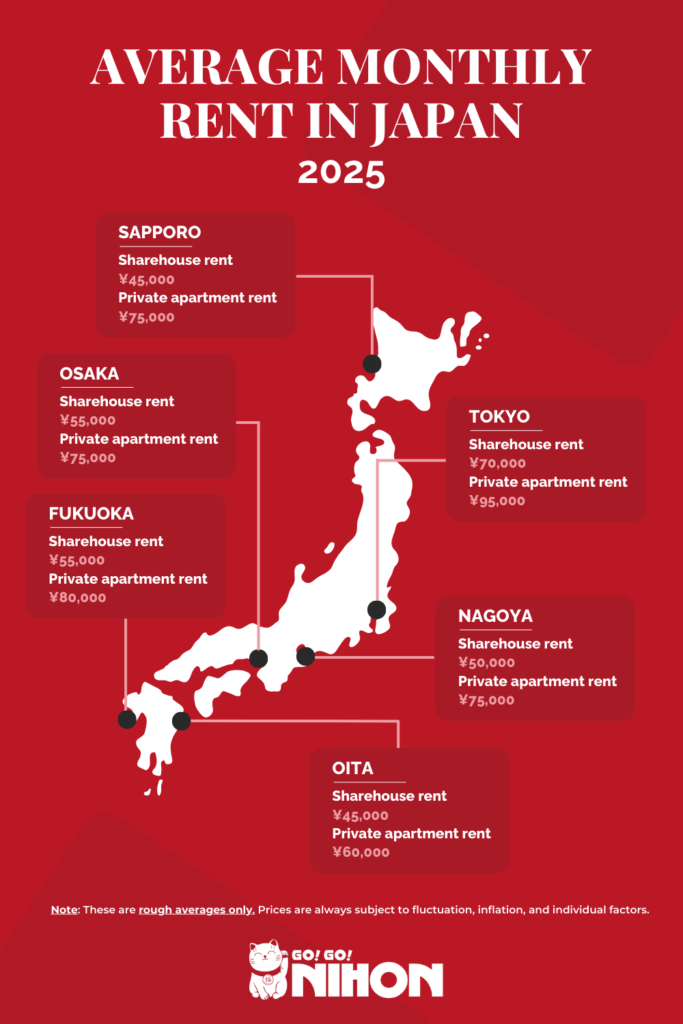
Let’s take a look at some average monthly costs, broken down by location.
**Note these are rough averages only. Prices are always subject to fluctuation, inflation, and individual factors. These include your lifestyle and spending habits, the area of the city you live in, the size of your accommodation, your accommodation provider, and more.
Rent and groceries, as well as other living expenses, have risen in recent years, so it’s always best to try and save as much as you can.
Costs are listed in Japanese Yen.
| Location | Sharehouse rent | Private apartment rent | Utilities | Groceries | Public transport |
| Tokyo | 70,000 | 95,000 | 18,000 | 48,000 | 6,500 |
| Yokohama | 65,000 | 85,000 | 17,000 | 48,000 | 6,500 |
| Osaka | 55,000 | 75,000 | 16,000 | 44,000 | 5,000 |
| Nagoya | 50,000 | 75,000 | 16,000 | 44,000 | 5,000 |
| Sapporo | 45,000 | 75,000 | 18,500 | 38,000 | 4,000 |
| Kobe | 55,000 | 70,000 | 15,500 | 44,000 | 4,500 |
| Fukuoka | 55,000 | 80,000 | 16,500 | 38,000 | 4,000 |
| Kyoto | 60,000 | 75,000 | 18,500 | 44,000 | 5,000 |
| Okayama | 45,000 | 60,000 | 16,500 | 40,000 | 4,000 |
| Oita | 45,000 | 60,000 | 16,500 | 38,000 | 4,000 |
| Kofu | 45,000 | 55,000 | 15,500 | 40,000 | 4,500 |
Average cost of food, drinks & entertainment
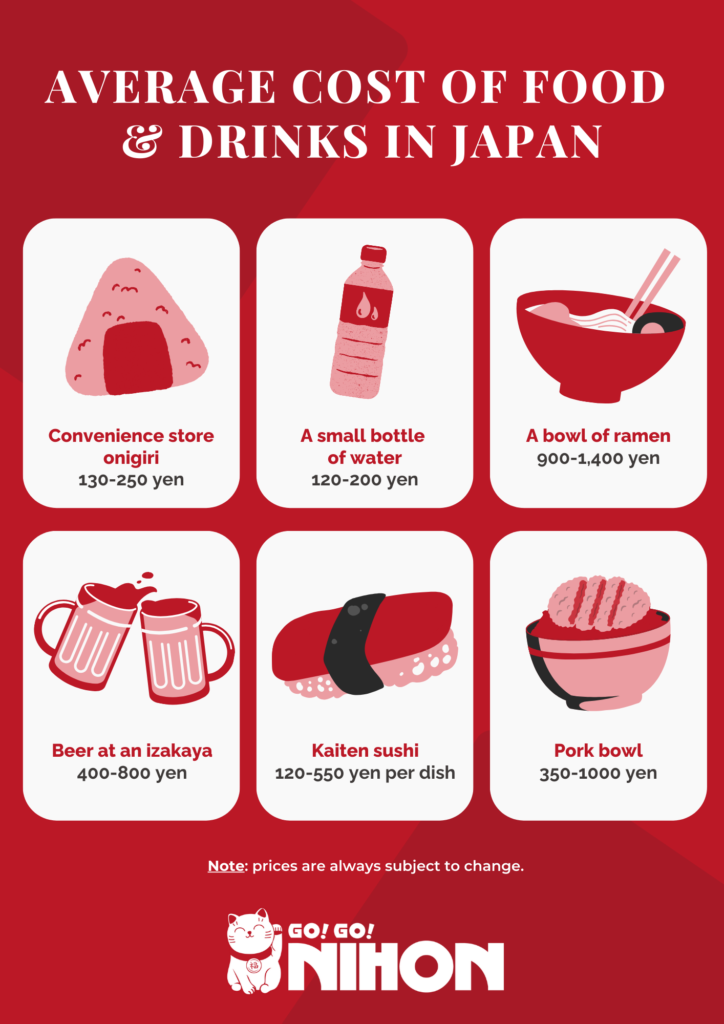
Like other costs in life, the price of food, drinks and entertainment will differ based on location, and the restaurant/cafe/entertainment venue. Prices have increased in recent years, particularly for food items, but affordable options are still widely available.
Here are some rough price ranges of what you can expect to pay for popular items.
Convenience store onigiri: 130-250 yen
A 550ml bottle of water: 120-200 yen
Pre-prepared meal bowl from supermarket e.g. soba, udon, pasta, katsudon, etc: 500-800 yen
A bowl of ramen: 900-1,400 yen
Kaiten (conveyor belt) sushi: 120-550 yen per dish
Beef bowl from Sukiya (large chain restaurant): 400-900 yen
Beer at an izakaya: 400-800 yen
A meal at an izakaya (including drinks): 2,500-4,500 yen per person
Movie ticket: 1,900-2,100 yen
Night club entry: Free to 4,500 yen
Standard tuition fees and costs
The cost of studying at a language school will depend on where you are studying and how long you’re studying for. Generally, the longer you study for, the more cost effective the fees end up being on average.
The total costs typically include:
- The student visa application fee
- School admission fee
- Tuition fee
- Material fees
- Facility fees
These costs always go directly to the school, not to Go! Go! Nihon if you are applying through our services.
Here are average tuition costs for 12 months of study based on location and the fees charged by our partner schools. Actual fees may vary slightly depending on the school and course.
Tokyo: 870,000-900,000 yen (avg. 885,000 yen)
Yokohama: 810,000-840,000 yen (avg. 825,000 yen)
Osaka: 830,000-860,000 yen (avg. 845,000 yen)
Nagoya: 790,000-820,000 yen (avg. 805,000 yen)
Sapporo: 790,000-820,000 yen (avg. 805,000 yen)
Kobe: 880,000-910,000 yen (avg. 895,000 yen)
Fukuoka: 810,000-840,000 yen (avg. 825,000 yen)
Kyoto: 850,000-880,000 yen (avg. 865,000 yen)
Okayama: 860,000-890,000 yen (avg. 875,000 yen)
Oita: 790,000-820,000 yen (avg. 805,000 yen)
Kofu: 740,000-780,000 yen (avg. 760,000 yen)
For specific course costs, please visit our language schools page.
Part-time wages
Students can work part-time up to 28 hours a week with a part-time work permit. Wages can vary from employer to employer and there is no national minimum wage amount. Each prefecture decides its own minimum wage based on various local factors.
In recent years, minimum hourly wages have increased across Japan. As of late 2025/early 2026, most prefectures have minimum wages in the 1,000-1,250 yen per hour range, with higher rates in larger metropolitan areas and lower rates in some regional areas.
For example:
- Tokyo and Yokohama area: often around 1,200–1,250+ yen per hour
- Osaka and other large cities: typically 1,100–1,200 yen per hour
- Regional prefectures: common ranges of 1,000–1,150 yen per hour
Because these rates are set locally and reviewed annually, they can change each fiscal year. Check the latest minimum wage tables published by the Japanese government or your prefectural authority for the most current figures.
Visit this website for a full table of minimum wages by prefecture.
We recommend students seriously consider their goals in learning Japanese in Japan when thinking about taking on part-time work. The primary purpose of your student visa is to allow you to study in Japan. You must be able to maintain high attendance and good grades, otherwise you may risk having your visa revoked.
Go! Go! Nihon works with a range of language schools across the spectrum of intensity level, from high intensity (no part-time work recommended), to lower intensity (more time to take on part-time work). Talk to us about your preferences so we can offer the best school for your needs.
Weighing up your options
There are many factors that go into your decision to live and study in Japan, with living costs being just one — but a significant one — of them. Be realistic about your financial situation and study goals when choosing where you want to study, what type of accommodation you want to live in, and the lifestyle you want.
Also keep in mind that to meet student visa application requirements, applicants are generally expected to show sufficient financial resources to cover living expenses and tuition, typically around 1 million yen per year of study at minimum.
This amount is considered a baseline only. In practice, applicants — especially those studying in higher-cost areas like Tokyo or Kyoto — should aim to show significantly more to ensure a smooth application and to better cover real living costs.
Go! Go! Nihon is always here to help, so don’t hesitate to contact us to help get your live and study in Japan journey started.