
Guide to Schools in Japan for International Students
This guide details how to study abroad in Japan for foreign students, including processes, visas, costs, top destinations, and expert tips. Discover more.
 Skip to content
Home • Studying Abroad in Japan • Schools in Japan • Japanese Language Schools
A guide to selecting the best Japanese language schools in Japan based on program specialty, visa regulations, course intensity, and location.

Japanese language schools offer a structured path to a student visa and real-world language skills. Since programs vary in intensity and pace, selecting one that fits your personal goals and learning style is essential.
By evaluating intensity, location, and visa rules, you can plan your budget and prepare for long-term success in Japan. This guide helps you compare options to start your journey.
By evaluating intensity, location, and visa rules, you can plan your budget and prepare for long-term success in Japan. This guide helps you compare options to start your journey. For a full overview of your educational choices, check out our comprehensive schools in Japan for international students roadmap, or explore our comprehensive guide on studying abroad in Japan.
Enrolling in a language school is the most reliable way to begin your journey in Japan. The pros of studying in a language school in Japan:
Learn more about how language schools in Japan operate to choose the right environment for your 2026 plans.
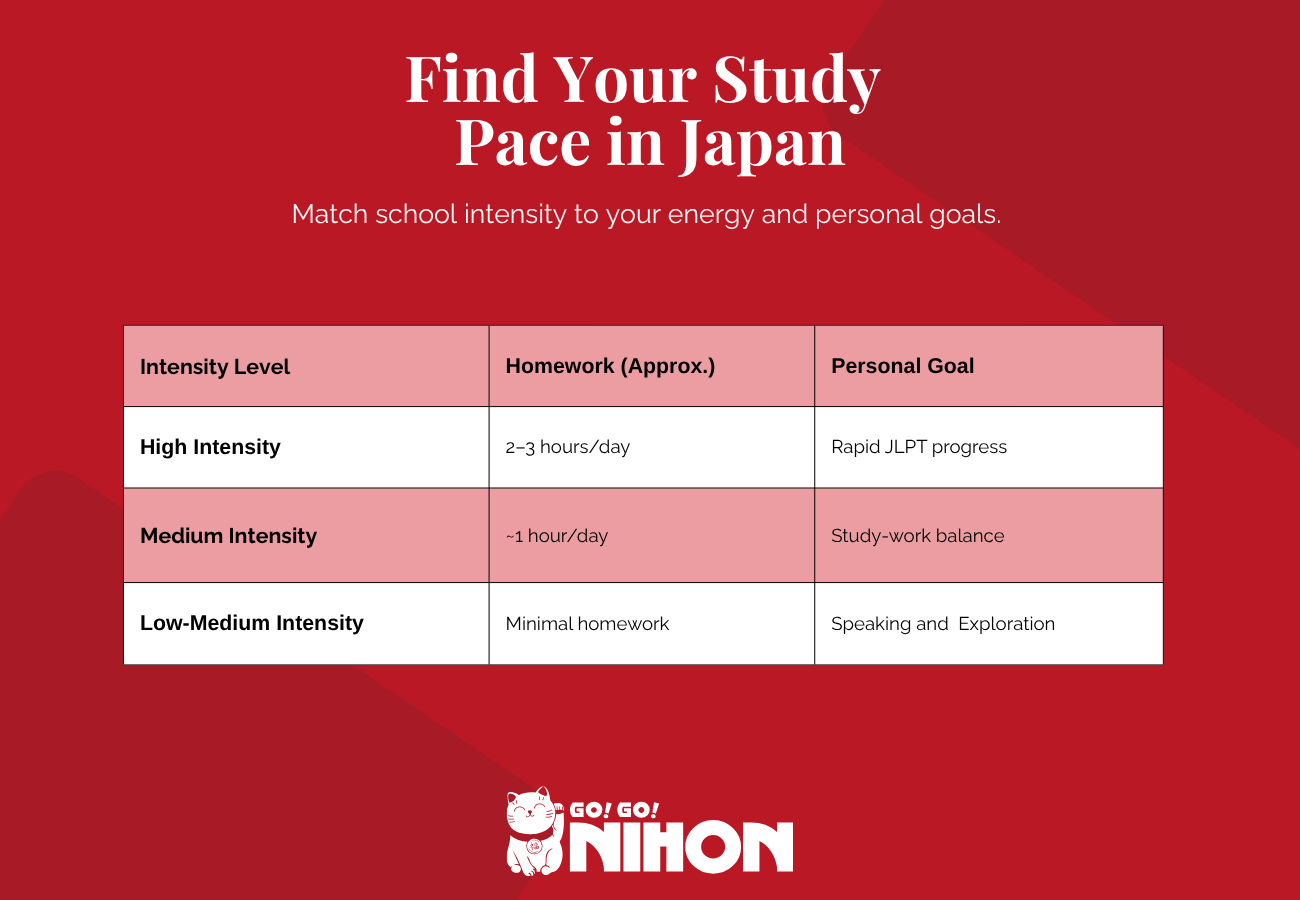
Matching your school’s intensity level to your daily energy and long-term goals is the best way to ensure a successful transition to Japan. Whether you are aiming for immediate conversational fluency or a corporate career, the pace of your language school in Japan will define your daily life. Selecting a program that aligns with your “learning comfort” level helps you avoid burnout and stay focused on your specific objectives.
Programs range from relaxed cultural immersion to high-pressure academic tracks. Understanding these tiers allows you to choose an environment where you can thrive without feeling overwhelmed by the curriculum.
Programs range from relaxed cultural immersion to high-pressure academic tracks. Understanding these tiers allows you to choose an environment where you can thrive without feeling overwhelmed by the curriculum.
Intensity Level | Typical Daily Workload | Best For |
High Intensity | 2–3 hours of homework | Students prioritizing on rapid language progression over free time. |
Medium-High | 1–2 hours of homework | Dedicated learners who want a more study focused life balance. |
Medium Intensity | ~1 hour of homework | Students who want a good study-life balance with time for a part-time job. |
Low-Medium | Minimal homework | Students who want to have less homework to balance more time exploring Japan alongside their studies. |
Low Intensity | Little to no homework | Students focus on social connections and experiences rather than fast language progress. |
Selecting a specialized track depends on whether your priority is immediate professional integration, entering a Japanese university, or a flexible cultural experience.
Track Type | Primary Goal | What You Will Learn | Recommended Schools |
Career-Oriented | Business etiquette, Keigo (honorifics), and Japanese resume writing. | ISI Shibuya, ARC Academy Tokyo, Interculture Language Academy (Kobe) | |
Academic Pathway | Rigorous prep for the EJU and JLPT to enter top universities. | ||
Short-term Options | Cultural immersion | Practical Japanese for daily life, often paired with seasonal activities. | Hokkaido Japanese Language Academy, Okayama Institute of Languages |
If you choose a career-oriented track, it is helpful to plan for local market realities early by reviewing our hub on working in Japan for international students. Alternatively, if you want quick, practical training to enter a technical field without a four-year degree, you can look into trade schools in Japan (Senmon Gakko) as your next strategic step.
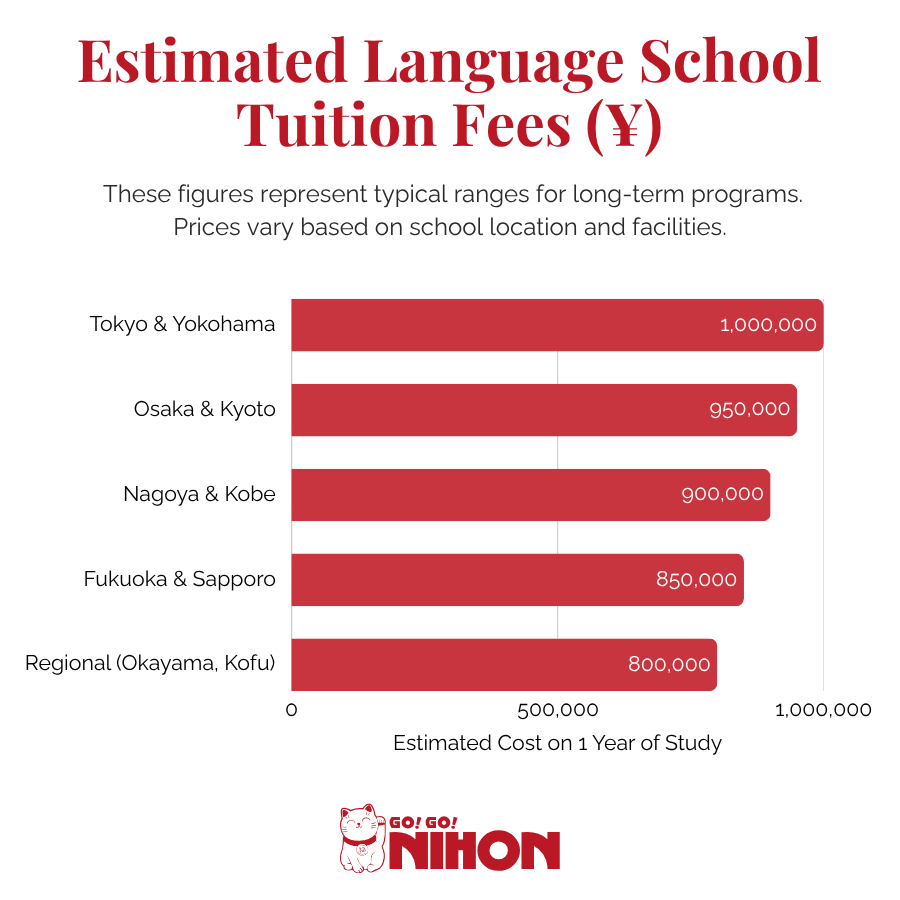
While tuition fees vary by school, most students plan for an initial investment that covers admission, materials, and tuition for their first six months.
For most institutions, you should expect to pay between ¥800,000 and ¥900,000 for the first year of tuition. For example, a high-intensity school in a central district like Naganuma School may have a higher fee structure compared to a regional school like Unitas Kofu, where living costs are also significantly lower.
While prices vary based on school location and facilities, most language schools in Japan offer short-term courses (typically 3 months) which can be completed on a standard tourist visa (visa waiver). This is an excellent way to start your studies without the complex documentation required for a long-term student visa. Understanding these initial costs, and the difference between short-term stays and long-term visa pathways, helps you build a roadmap that is financially sustainable.
Region / City | Estimated Annual Tuition (Range) | Affordability Tier |
Tokyo & Yokohama | ¥800,000 – ¥1,000,000 | High |
Osaka & Kyoto | ¥750,000 – ¥950,000 | Moderate |
Nagoya & Kobe | ¥700,000 – ¥900,000 | Moderate |
Fukuoka & Sapporo | ¥650,000 – ¥850,000 | Budget-friendly |
Regional Hubs (Okayama, Kofu) | ¥600,000 – ¥800,000 | Budget-friendly |
Note on Estimates:
These figures represent typical ranges for long-term programs. Prices vary based on school facilities and program intensity. For pricing on schools please visit our Japanese language school page.
Choosing the best city depends on balancing your career goals with your lifestyle; Tokyo is the undisputed hub for networking, while regional cities like Fukuoka and Okayama offer lower rent.
Tokyo hosts over 107,000 international students, roughly 32% of the national total, making it the primary destination for global networking. However, cities like Okayama and Fukuoka are becoming favorites for Western students seeking deeper community integration and higher quality of life.
To help you decide, we have analyzed the best places in Japan for studying abroad based on student priorities such as cost of living, job markets, and lifestyle.
DID YOU KNOW?
Outside of Tokyo, the Kansai region (Osaka and Kyoto) remains a powerful academic corridor, hosting over 50,000 international students at world-renowned research institutions.
The length of your school day in Japan depends on the type of institution you choose, ranging from half-day language immersion to full-time academic or vocational training. Understanding these schedules helps you plan your time for focused study, part-time work, and exploring your new community.
School Type | Typical Schedule / Duration | Notes |
Language Schools | Half-day sessions, 3.5 to 4 hours | Morning or afternoon block, leaving time for homework/activities. |
Vocational Schools (Senmon Gakko) | Full-time, approximately 9:00 AM to 4:00 PM or 5:00 PM, Monday–Friday | Rigorous schedule to gain practical, industry-standard skills (ex: Yokohama Design College). |
Universities and Graduate Schools | Varies significantly (credit-based) | Flexible course loads depending on major and semester, allowing for research and academic commitments. |
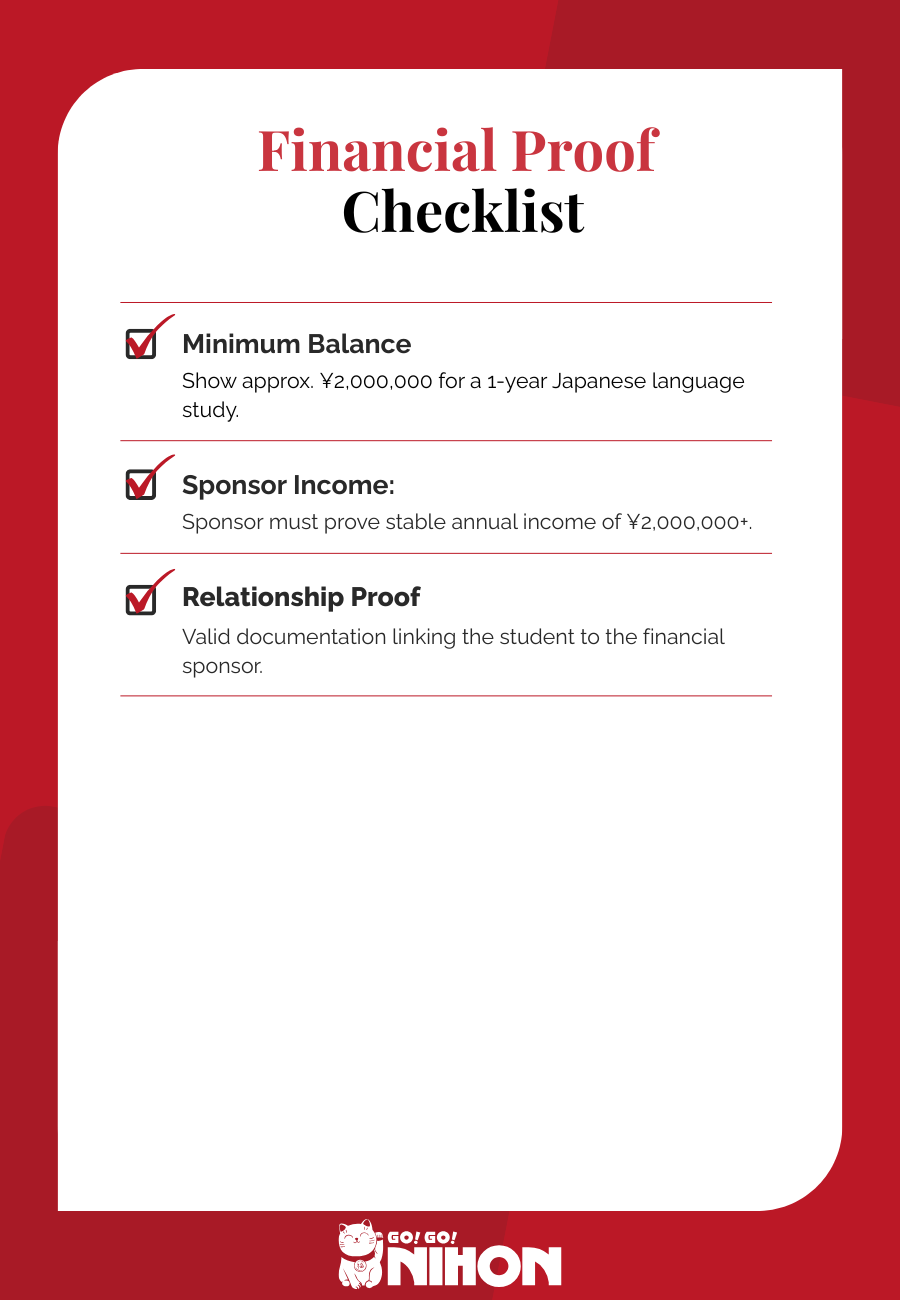
To obtain a Certificate of Eligibility (COE), Japanese immigration requires proof that you or your financial sponsor can support your tuition fees and living expenses. While there is no official “fixed” amount, the standard recommendation is to show a bank balance equivalent to at least 2,000,000 yen for a one-year stay.
For different course lengths, the general guidelines are:
Additionally, financial sponsors must demonstrate a stable annual income of at least 2,000,000 yen to be approved by immigration authorities.
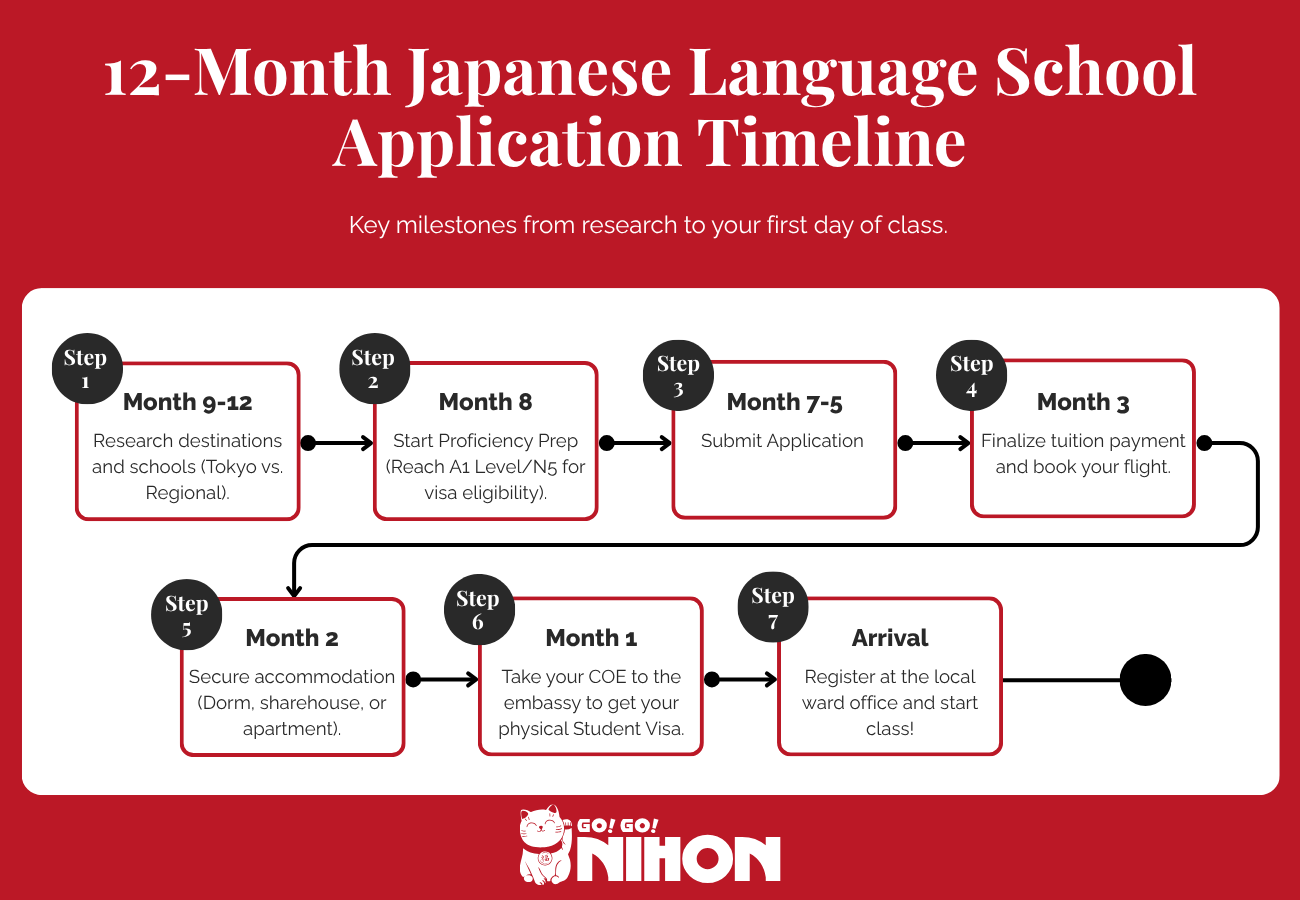
Securing a Japanese student visa is a structured process that should begin at least six to eight months before your intended start date. To make sure your documentation is correct and to understand the complete application timeline from start to finish, see our step-by-step breakdown on how to apply for a Japan student visa.
As of April 2026, Japanese immigration policy has shifted from counting study hours to verifying actual proficiency. Most applicants are now required to demonstrate at least an A1 level of ability (equivalent to JLPT N5) to qualify for a student visa. If you do not have a test center near you or need to build this foundation from home before applying, you can explore your options for online Japanese language lessons to clear this prerequisite.
The most secure way to satisfy this requirement is to provide an official certification from one of the following recognised exams:
Recognized Exam | Minimum Level / Score | Administering Body |
JLPT | N5 or higher | Japan Educational Exchanges and Services / The Japan Foundation |
BJT | 300+ | Japan Kanji Aptitude Testing Association |
J.TEST | Grade F or 250+ in FG level | Japanese Language Proficiency Association / J.TEST Secretariat |
NAT-TEST | Level 5+ | Specialized Educational Publishing |
STBJ | 350+ | Japan Association for Applied Japanese Language Education |
TOPJ | Beginner level A or higher | TOPJ Practical Japanese Proficiency Test Implementation Committee |
J-cert | Beginner level or higher | Japan International Human Resources Development Foundation |
JLCT | JCT5 or higher | Japan Organization for Japanese Language Proficiency Testing |
PJC Bridge | C- or higher | Certify Co., Ltd. |
JPT | 315+ (or 68+ on Elementary Test) | Japanese Language Proficiency Test Implementation Committee |
JT5 | JT5 or higher (Online) | Global Coexistence Society Promotion Organization |
S-JEP | 300+ | Surugadai Gakuen Educational Foundation |
In specific cases, a school may conduct a formal interview or assessment to verify that your Japanese knowledge meets the required A1 level if you do not yet have a certificate.
DID YOU KNOW?
While 150 hours of study is no longer a direct way to meet visa requirements, completing a structured online course like our Akamonkai beginner course can support your preparation for JLPT N5 exams or assessments.
Missing an application deadline can delay your move by several months, so starting your preparation early is the best way to keep your plans on track. Because schools operate on distinct intake seasons, knowing how Japanese language school terms work will ensure you submit your paperwork to immigration months before you actually arrive in the country.
Language schools have fixed intake periods, and missing a deadline can delay your plans by several months. To meet your entry requirements, you must submit your application well before the official immigration cutoff.
If You Want to Start in: | Submit Application By: | COE Result Released |
April | September (previous year) | Late February |
July | January (current year) | Late May |
October | March (current year) | Late August |
January | July (previous year) | Late November |
Pro Tip
Popular schools often reach capacity long before the official immigration deadline. We recommend starting your application as early as possible to make sure you get a spot in your first-choice school.
You can typically start at a language school or university in Japan at 18 years old, as these institutions require the completion of 12 years of formal education (high school graduation). While there is no official upper age limit, immigration authorities may more closely review the “study intent” of applicants over 30 or those with significant gaps in their education and work history.
School Type | Target Audience/Requirement | Key Consideration |
Language Schools | Adults of all ages (from recent high school graduates to retirees). | Mature students should clearly explain how learning Japanese benefits their career or personal goals. |
Universities and Vocational Schools | Students who have completed secondary education. | Students from 11-year secondary education systems may need a “preparatory year” to meet the Japanese 12-year requirement. |
Go! Go! Nihon provides a personalized service to help you select the ideal institution from our vetted network based on your unique professional goals and learning comfort.
Selecting the right academic pace is the most effective way to avoid study abroad burnout, which is why our expert advisors offer free, high-touch support in seven languages to match your learning style with a program that ensures long-term success. We eliminate the administrative friction of the visa application and support logistical details like accommodation.
Read inspiring success stories of international students who successfully studied in Japan with the support of Go! Go! Nihon.
Learn more about studying abroad in Japan with Go! Go! Nihon.
Japanese language schools in Japan are one of the best first steps for anyone looking to build a future in the country. In 2024, over 100,000 international students chose this pathway, not only to improve their Japanese but to experience daily life, connect with local communities, and better understand how to live and work in Japan.
Choosing the right school means finding a programme that fits your goals and learning style, whether you are preparing for further study, employment, or long-term life in Japan. Factors such as course intensity, location, and intake timing can all shape your experience.
With the right approach, language school becomes more than just classroom study. It offers a structured way to develop language skills, build confidence in real-world situations, and start exploring opportunities within Japan’s education system and job market.
Ready to find your best fit? Contact Go! Go! Nihon today for free support in choosing your school and managing your student visa application.
If you are still exploring your options, view our full selection of Japanese language schools to compare locations, intensities, and features across Japan.
If your long-term goal involves pursuing a higher academic degree directly in English rather than doing full Japanese immersion first, you can read our guide on universities in Japan that teach in English.
This guide details how to study abroad in Japan for foreign students, including processes, visas, costs, top destinations, and expert tips. Discover more.

This guide details how to study abroad in Japan for foreign students, including processes, visas, costs, top destinations, and expert tips. Discover more.

This guide details how to study abroad in Japan for foreign students, including processes, visas, costs, top destinations, and expert tips. Discover more.

This guide details how to study abroad in Japan for foreign students, including processes, visas, costs, top destinations, and expert tips. Discover more.

This guide details how to study abroad in Japan for foreign students, including processes, visas, costs, top destinations, and expert tips. Discover more.