Skip to content


Updated February 2026
Depending on where you live in the world you may or may not be familiar with the seasonal sniffles of hay fever, but hay fever in Japan is very common and particularly intense.
With distinct seasons comes strong flora and lots of pollen floating around. You may find that when visiting Japan you start experiencing it for the first time. We’re here to walk you through the symptoms and the remedies of kafunshō (花粉症) or hay fever.
Note: Due to various environmental factors, the temperatures in Japan have risen to extreme levels on some days during the summer and are expected to continue to do so. Please note that due to this, the level of pollen may increase and those that are more sensitive to this (i.e. allergies) may have some issues traveling outdoors. We would recommend taking the necessary precautions during this season.
What causes hay fever in Japan?
Hay fever in Japan can be particularly bad for many — not because of the sakura that many of us might assume is the cause — but because of two types of cypress trees called sugi (Japanese cedar) and hinoki (Japanese cypress) that release massive amounts of tree pollen in the spring months from around February through to May as it moves across the country.
Following WWII, there was large scale planting of the two species to boost forestation and provide materials for the construction industry. Little did they know that it would have a major impact on the population. Today, an estimated more than 42.5% of people living in Japan suffer from some form of hay fever, making it so common that it’s been dubbed a “national disease.”
Hay fever or a cold?
If you’ve never experienced kafunshō before then you might not know that many of the symptoms are similar to that of a cold. The key difference is that hay fever symptoms appear suddenly when exposed to pollen, worsen on dry and windy days, and improve on rainy days or when indoors. Unlike colds or flu, hay fever doesn’t include fever but often involves intense itching. It can also cause shortness of breath on heavy pollen days.
One of the best things to do is to head to the pharmacist or a clinic specialized in jibika (耳鼻科, otolaryngology) if your symptoms are particularly bad. Once you’re there though it will be useful to describe your symptoms so that you can get the treatment that’s best for you.
My eyes are itchy — me ga kayui (目が痒い)
I have a runny nose — hanamizu ga deru (鼻水が出る)
My eyes are red — me ga akai (目が赤い)
To sneeze — kushami ga deru (くしゃみが出る)
Stuffy nose — hanazumari (鼻づまり)
I feel bad — kibun ga warui (気分が悪い)
My throat is scratchy — nodo ga igaiga suru (喉がイガイガする)
How to treat it
The otolaryngologist will be able to prescribe you stronger antihistamines than you are able to get in the pharmacy. Managing hay fever is most effective when treatment begins shortly before the pollen season peaks — ideally in late January or early February. There are a few other ways that you can battle the symptoms of hay fever in Japan:
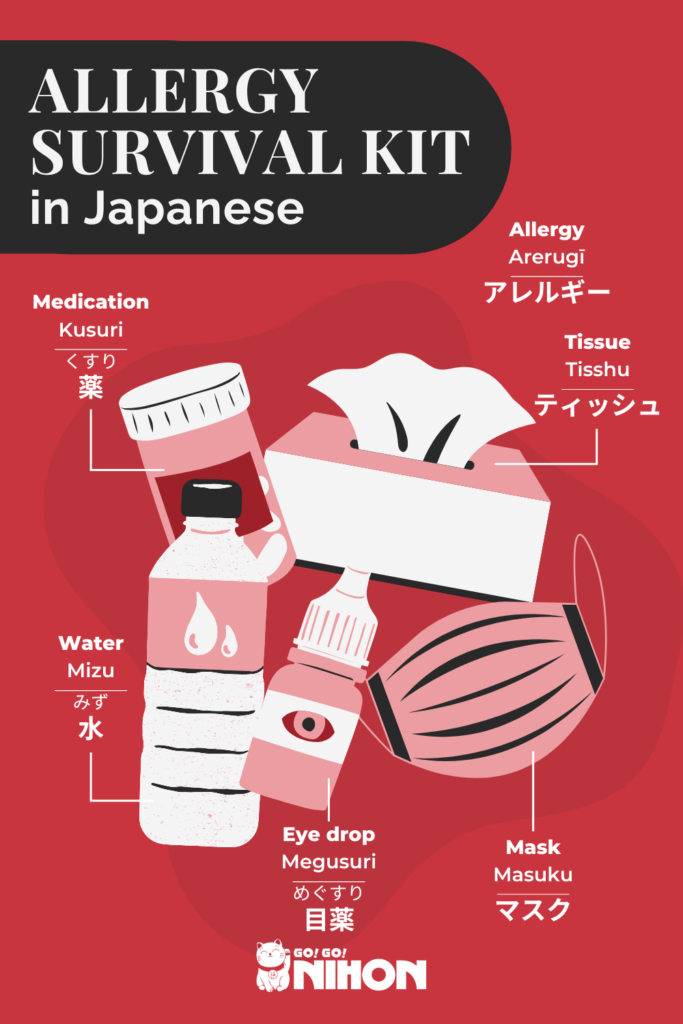
Mask
Masks are incredibly easy to come by in Japan, as you might expect. They will help keep the pollen away from your nose, and your friends and colleagues will appreciate not having to see your runny nose.
Look for masks specifically labeled for pollen (花粉症用/kafunshō-yō), which have tighter weaves and better filtration than standard masks.
Eyewash & eye drops
Everyone tends to be affected differently, but the differentiating factor of hay fever from colds are the itchy eyes. Both eye drops and eyewash can be easily found at the pharmacy or drug store and will help wash the pollen out of your eyes.
Antihistamines & medications
For those in the UK and the US, antihistamines are the go-to treatment for hay fever. Thankfully there are plenty available in Japan as well. This is fortunate, given the restrictions on bringing medicine into the country. Check out our article here for more details.
Some of the most effective over-the-counter products available at Japanese pharmacies include:
- Contac Rhinitis Z (コンタック鼻炎Z) – Contains 10mg of Cetirizine (same as Zyrtec). Takes one dose per day. May cause slight drowsiness, so taking before bedtime is recommended.
- Claritin EX (クラリチンEX) – Contains 10mg of Loratadine. Non-drowsy formula, so you can take it any time of day.
- Allerbi (アレルビ) – A cost-effective alternative containing 60mg of Fexofenadine (same as Allegra). Requires two doses per day.
- Alesion (アレジオン) – Another popular option available at most pharmacies.
Nasal sprays like Nasaline and Nazal Spray can also help reduce inflammation and provide relief from stuffy or runny noses.
Other helpful measures
If it’s really bad then you can even invest in a humidifier or air purifier for your room or apartment. Some very modern air conditioning units will have good air filters in them but if you find you have particularly bad symptoms, it might be worth the investment so that you can stop sneezing and find some comfort at home.
Pollen blocker sprays are also available that use ion powder to prevent pollen from entering your eyes, nose, and mouth. For severe allergies that don’t improve with medication, consider immunotherapy (allergy shots or sublingual tablets) for long-term relief.
Track the pollen forecast
Another useful way to help reduce your suffering is to keep an eye on the pollen forecast so that you can be prepared for a bad day. Just as you might follow the sakura forecast, the pollen forecast for the cypress trees can be monitored too.
There are several easy-to-use online tools to help you stay on top of the pollen situation. Weather Underground provides daily pollen and air quality forecasts for Tokyo and other major Japanese cities, while IQAir offers real-time pollen counts and allergy risk levels broken down by city across the whole country. For a quick daily snapshot of tree, grass and weed pollen levels alongside air quality data, Pollen.city is another handy option.
Additional prevention tips
- Shower and change clothes after being outside to remove pollen from your body
- Keep windows closed during high pollen periods
- Use air purifiers indoors
- Consider wearing pollen-guard glasses
- Use nasal saline rinses to wash pollen out of your nose
If you like to read more about Japanese culture, make sure to follow our blog where we cover everything you need to know about Japan.