HomeStudying Abroad in JapanSchools in Japan for International StudentsEnglish-Taught Universities in Japan

Universities in Japan that Teach in English for International Students

Start your Japanese degree immediately with English-taught programs.

Explore Japan's leading English-medium universities. Evaluate tuition fees, entry criteria, and professional prospects for students from abroad.

English-taught programs in Japan offer a direct pathway to obtaining a student visa, allowing you to begin your academic journey straight away, even if you don’t yet speak Japanese. These degrees are internationally recognised, tuition fees are often more affordable than in other major study destinations, and many programs are designed with strong career outcomes in mind. 

Japan is also becoming an increasingly popular destination for international students, with 336,708 choosing to study there in 2024. This growth reflects a broader national effort to welcome global talent and create more accessible pathways into higher education and employment.

Key takeaways

  • Studying Without Japanese: You can start your undergraduate or master’s degree immediately through English-Taught Programs (ETP) while learning Japanese as a secondary subject. This is one of the gateways for the record 229,467 international students in Higher Education Institutions in Japan.
  • Why Choose English-Track Programs: These degrees offer a high ROI, with tuition costs often 30% to 50% lower than comparable universities in the US or UK. Students gain direct access to the Japanese labor market and build “cross-cultural resilience” during their studies.
  • Top English-Taught Universities: Elite institutions such as Ritsumeikan APU and Hosei University report that the vast majority of their graduates successfully transition into professional roles immediately after completing their degrees. GLOBIS University graduates see an average 18% salary increase before even completing their MBA.
  • Tuition and Costs: Annual tuition for English programs starts at ¥535,800 at national universities and ranges up to ¥1.5 million at private institutions. Recent currency shifts make these programs 20% to 30% more affordable for international applicants.
  • Admission Requirements: Most programs require 12 years of formal education and proof of English proficiency via TOEFL or IELTS. You must also provide financial proof showing approximately ¥4 million for visa approval.
  • The Application Process: Entry typically involves an online application, a statement of purpose, and academic transcripts. Go! Go! Nihon provides free guidance to help you understand these requirements and secure your spot.
  • Career and Visa Success: Graduates from Japanese universities hold the same qualifications as domestic students, allowing them to find work in Japan more easily. Major hiring sectors include Information and Communications, Finance, and Global Manufacturing.
Quick university comparison

Quick University Comparison: English-Taught Universities in Japan

Table: This comparison summarizes the 2024 and 2025 career outcomes and institutional focus for our four partner universities. All data points reflect the most recent official reports for international students and graduates.

Feature

Academic Focus

Employment Rate

Salary/Promotion

Ritsumeikan APU

Multicultural Leadership & Global Business

330 International students secured job offers in 2024

Ranked 2025 Employers’ Choice of University

GLOBIS University

Practical Business (MBA) & Entrepreneurship

65.7% (within 3 months) / 75% stay in Japan

18% average salary increase by graduation

Eikei University

Social System Design & Liberal Arts

91.7% (of job-seeking applicants)

Focus on startup and global company entry

Hosei University

Traditional Liberal Arts

86.1% overall (94.1% for Graduate students)

High stability; rates rose from 83.7% in 2023

Universities in Japan that teach English

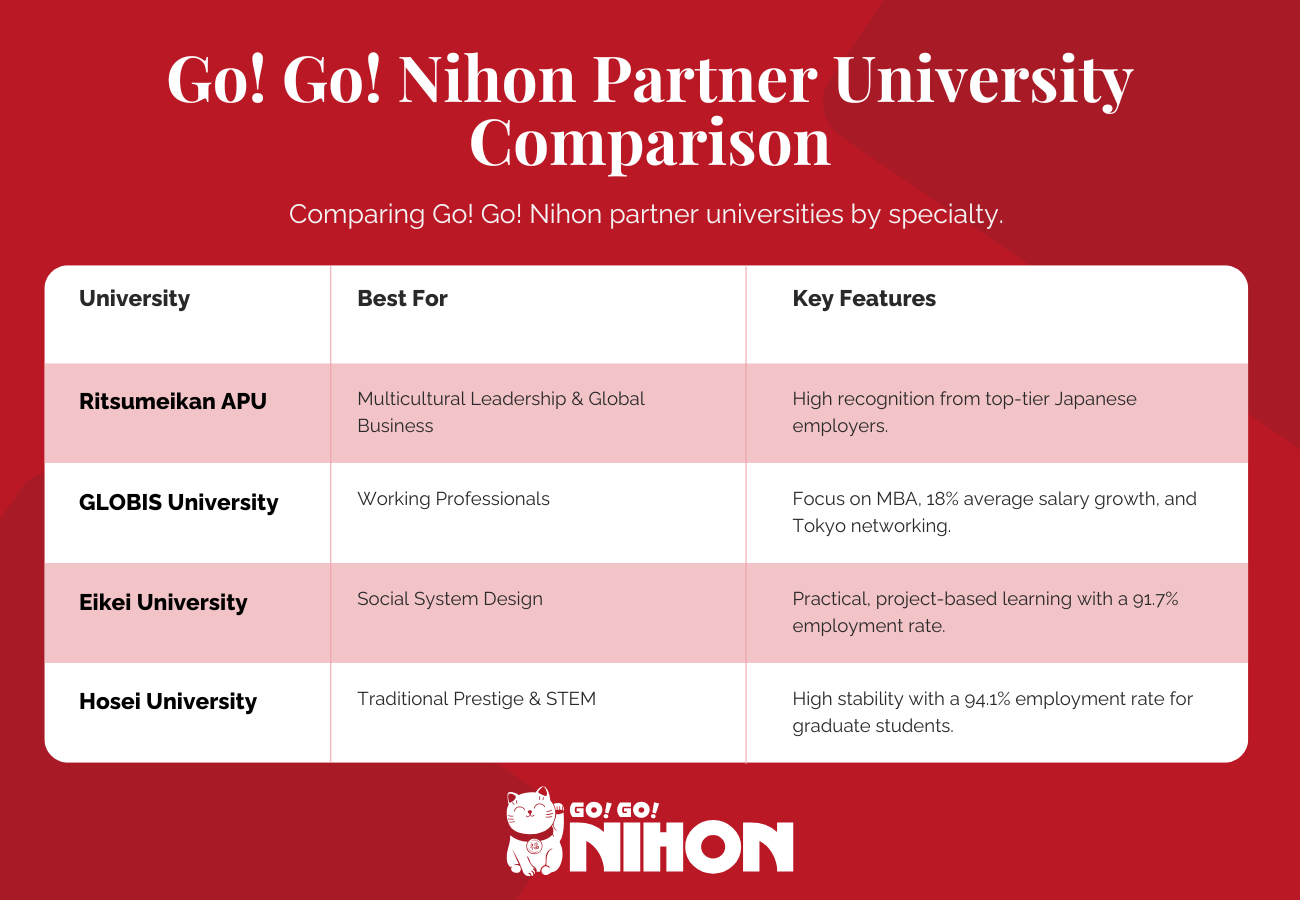
Which universities in Japan teach in English?

Side-by-side comparison of English-taught programs at Ritsumeikan APU, GLOBIS, Eikei, and Hosei.
A strategic comparison guide for universities in Japan that teach in English, highlighting job placement rates, locations, and academic focus.

We partner with prestigious institutions, such as Hosei University, Ritsumeikan APU, and GLOBIS, which offer specialized English-taught programs in business, social sciences, and sustainability.

1. Hosei University

Hosei University is one of Japan’s oldest and most prestigious private institutions, known for its commitment to global engagement and practical education. The university consistently produces high employment outcomes for its international student body across both undergraduate and graduate levels.

  • Strong Career Outcomes: Hosei University reports an overall job placement rate of 86.1% for international graduates in 2025. Graduate school students achieved an even higher success rate of 94.1%.
  • Diverse Academic Success: Undergraduate students maintained a steady 82.8% employment rate. Specific departments, such as the Faculty of Letters, reported success rates of 85.9%.
  • Science and Engineering Excellence: International students in technical and scientific fields saw placement rates as high as 92.3%. Graduate programs in science and engineering frequently reach nearly 100% employment.
  • Global Student Network: The university supports a diverse community of 293 international students from countries including China, South Korea, Taiwan, Vietnam, Thailand, and the United Kingdom.
  • Consistent Performance: The university has maintained high placement rates over the years, with 85.3% in 2024 and 83.7% in 2023. This stability reflects a robust support system for international career development.

Source: Employment Status of International Students (3 Years)

2. Ritsumeikan Asia Pacific University (APU)

Ristumeikan Asia Pacific University (APU) is a premier destination for multicultural education, with a student body representing over 100 countries and a nearly 1 to 1 ratio of domestic to international students. The university is specifically designed to produce graduates who can thrive in global business and social innovation.

  • High Job Placement Success: In the AY 2024 cohort, 834 graduates successfully secured job offers before completing their degrees. For those who choose to continue their academic growth, 91 international graduates moved directly into advanced studies at graduate schools.
  • Strong Tokyo Network: Despite being located in Oita, APU has powerful ties to the capital. Approximately 57.8% of all job placements are located in the Kanto (Tokyo) region, followed by 19.7% in the Chubu and Kinki areas.
  • Diverse Industry Entry: Graduates enter a wide range of professional fields. Major sectors include the Service industry (32.5%), Manufacturing (17.4%), and the Telecommunications industry (14.6%).
  • Global Career Pathways: The university supports diverse career outcomes. Outside of corporate roles, 5.0% of graduates successfully entered civil service positions in Japan and overseas.

Source: Job Placement and Advancement – Ritsumeikan Asia Pacific University

3. GLOBIS University

GLOBIS is Japan’s largest business school, offering a practical, network-heavy MBA in the heart of Tokyo. The program is designed for professionals who want to accelerate their careers in the Japanese business ecosystem.

How the GLOBIS MBA Changes Lives

  • 18% Salary Growth: Graduates reported an average 18% increase in salary by the time of graduation.
  • 86% Career Advancement: An overwhelming 86% of students experienced a significant positive change in their career trajectory before completing the program.
  • 96% Leadership Mastery: Approximately 96% of graduates successfully developed the high-level leadership skills required for senior management roles.

Source: Globis University 2024 Survey Results

4. Eikei University of Hiroshima

Eikei University focuses on “Social System Design,” using a practical, project-based curriculum to prepare students for the global labor market. The university incorporates hands-on experience directly into its degree programs, requiring all students to complete at least two internships or volunteer placements with real-world organizations.

  • High Employment Success: Among the university’s 48 job-seeking graduates, 91.7% (44 students) secured positions with companies and organizations, while 8.3% (4 students) successfully entered the civil services. (Source: Eikei University of Hiroshima)
  • Major Industry Placements: The highest concentration of graduates entered the Information and Communications (IT and mass media) and Finance and Insurance sectors, though placements remain highly diverse due to the school’s cross-disciplinary approach.

Integrated Liberal Arts Education: By merging humanities and sciences, the curriculum nurtures the specific interests of each student over four years of study. This results in career outcomes that reflect both individual professional goals and the diverse needs of different industries and regions.

Selecting your ideal English-taught university

University

Best For

Ritsumeikan APU

Students seeking a truly global environment and high recognition from top-tier Japanese employers.

GLOBIS University

Working professionals aiming for an immediate salary jump and leadership transitions within the Tokyo business ecosystem.

Eikei University of Hiroshima

Undergraduates who want hands-on, project-based learning and guaranteed internship experience.

Hosei University

Students looking for the prestige of a traditional private university with specialized success in STEM and science-related graduate roles.

University tuition in Japan

How much is university in Japan for international students?

Tuition at Japanese universities is significantly lower than in the US or UK, with private institution fees often ranging between ¥1.4 million and ¥1.6 million per year.

Important: Please note that Go! Go! Nihon does not provide application support for scholarships or financial aid programs. You must apply for these opportunities directly through the university or the providing organization.

University

Yearly Tuition (approx.)

Scholarship Opportunities

Hosei University

¥1,450,000

50% Tuition Reduction

Ritsumeikan APU

¥1,512,740

30%–100% Tuition reduction

GLOBIS (MBA)

¥3,845,000 (Total)

Available Financial Aid

Eikei University of Hiroshima

¥952,260

50% Tuition Waiver and grant-based scholarships

For families used to the high costs of US or UK systems, these rates represent exceptional value, especially when combined with a clear pathway to a work visa.
Japanese university admission requirements

What are the Japanese university admission requirements for international students?

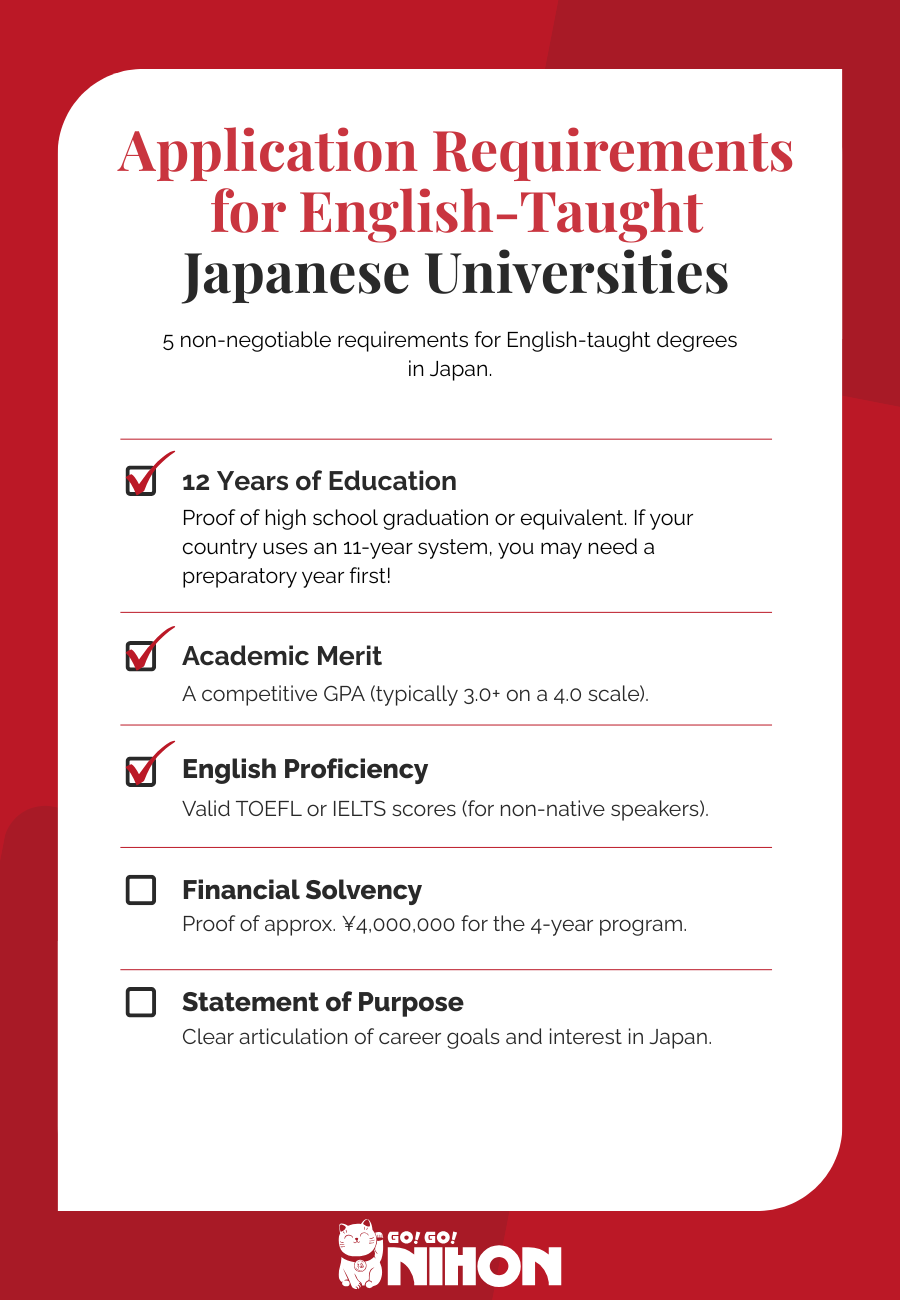
Checklist of admission and visa requirements for English-taught universities in Japan.
A visual guide detailing the academic and financial benchmarks required for international students to apply directly to Japanese universities in English.

Applying to a Japanese university requires meeting a strict baseline of 12 years of formal education, proving financial stability, and providing English qualifications if you are from a non-native English speaking country. 

Top universities in Japan like Hosei University, Ritsumeikan Asia Pacific University (APU), and Eikei University of Hiroshima use a holistic review process to confirm that applicants are prepared for the academic and cultural demands of studying in Japan.

Overview: Admission requirements English-taugth Universities in Japan

The table below summarizes the core entry criteria for a student visa and school placement at Japanese language schools, vocational or trade schools, and universities. More detailed descriptions follow.

Requirement Category

Specific Criteria

Essential Documentation

Basic Education

Completion of 12 years of formal schooling

High school diploma or graduation certificate

Academic Merit

Competitive grades, typically a minimum 3.0 GPA

Academic transcripts and SAT, ACT, or IB scores

English Proficiency

Required for students from non-native English speaking countries

Official TOEFL or IELTS scores

Japanese Proficiency (for Japanese-Taught Programs)

JLPT N2 level

EJU (Examination for Japanese University Admission)

Financial Solvency

¥4 million for the 4-year program

Bank balance certificates (3-year history may be required)

Holistic Assessment

Clear articulation of career goals and interest in Japan

Statement of Purpose and letters of recommendation

DID YOU KNOW?

If your home country uses an 11-year education system, you are not immediately disqualified. You may simply need to complete a designated university preparatory course to meet the 12-year requirement before you submit your final application.

Academic and Language Prerequisites

To be admitted into any Japanese university, you must meet specific educational and linguistic benchmarks:

  • 12 Years of Formal Education: A non-negotiable requirement is the completion of 12 years of formal education in your home country, typically verified by high school graduation. To better understand these benchmarks, you can learn about the Japanese education system and how it compares to the West. If your home country follows an 11-year system, you may be required to complete a designated university preparatory course before applying.
  • English-Taught Programs (ETPs): These degrees allow you to start your academic studies immediately without prior Japanese proficiency. You can apply using standardized test scores from your home country, such as the SAT, ACT, or IB (International Baccalaureate). If you are not from a native English-speaking country, you must also provide English qualifications, such as TOEFL or IELTS scores, to prove your language readiness. ETPs at prestigious institutions like Hosei University, Ritsumeikan Asia Pacific University (APU), and Eikei University of Hiroshima provide an efficient route for students to build cultural intelligence while studying in English.
  • Japanese-Taught Programs: If you plan to study in Japanese, you must take the EJU (Examination for Japanese University Admission). Most universities require a JLPT N2 level and a score of 250 or higher on the EJU’s Japanese section. 
  • GPA Requirement: Most English-taught tracks use a direct admission process based on your home country’s transcripts and scores from tests like the SAT or ACT. This bypasses the need for the Examination for Japanese University Admission (EJU), which is typically required for traditional Japanese-medium tracks. Choosing an ETP is the most efficient route for students who want to master cultural intelligence while completing their degree in English.

DID YOU KNOW?

Because of the high language barrier for Japanese-track degrees, many international students spend 1 to 2 years at a Japanese language school first to bridge the gap and prepare for the EJU.

Holistic Application and Documentation

The university admissions process in Japan for English-taught programs is highly holistic, meaning officials look at more than just your grades. You will be required to submit academic transcripts, letters of recommendation, and a meticulous Statement of Purpose. 

Immigration and university officials heavily scrutinize this statement. It must clearly articulate why you chose Japan over other countries, how the specific institution aligns with your long-term career goals, and your intentions for staying in the Japanese workforce after graduation.

Financial Solvency Requirements

Proving that you can afford to live and study in Japan is one of the most rigorously vetted parts of the process.
  • The Financial Threshold: You must prove that you or your financial sponsor have access to approximately ¥4,000,000. This amount is intended to demonstrate your ability to cover tuition and living expenses for the entire duration of a four-year degree.
  • Required Proof: Documentation must include bank balance certificates issued within the last three months, your sponsor’s income and tax certificates, and a 3-year funding history.
  • Vetting Standards: Immigration prefers to see steady income and savings growth. Sudden, large deposits into a bank account prior to applying can raise red flags and may lead to a visa rejection.

The Visa and COE Process

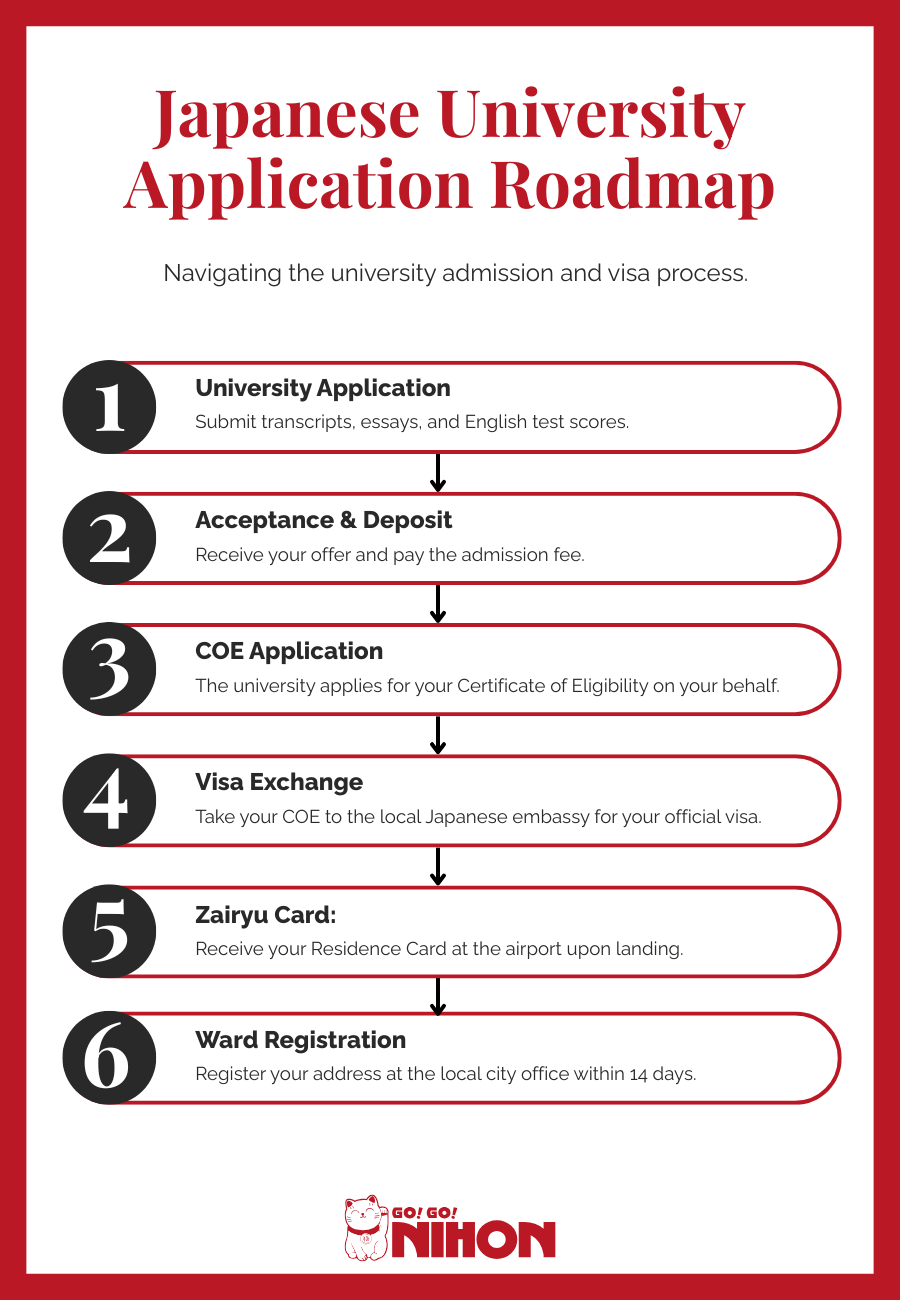
Step-by-step roadmap from university acceptance to obtaining a student visa for Japan.
A process infographic mapping out the timeline for university application, COE issuance, and final residency registration for international students.

Once a university accepts your application, you must navigate a multi-step bureaucratic process to enter the country.

  • Certificate of Eligibility (COE): The university acts as your proxy and applies to the Japanese Immigration Services Agency for your Certificate of Eligibility (COE). This generally happens 1 to 3 months after your financial documents are submitted.
  • Visa Conversion: Once the COE is issued and sent to you, you must take it to your local Japanese embassy or consulate to exchange it for a Japanese Student Visa. This step usually takes 2 to 4 weeks.
  • Arrival Procedures: Upon arriving in Japan, you will receive a Residence Card (Zairyu Card) at the airport. You are legally required to register this card at your local city or ward office within 14 days of moving in. You can learn more about the final steps after applying for a visa for Japan to ensure a smooth transition.
University tuition in Japan

How much is university in Japan for international students?

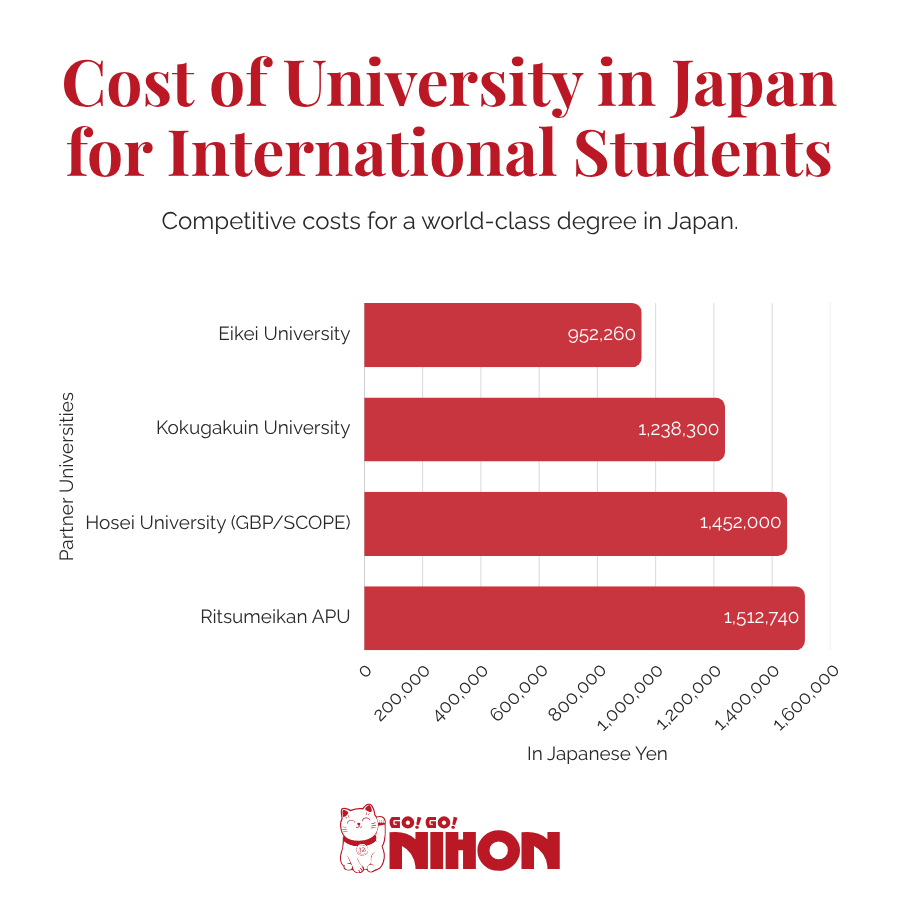
University tuition in Japan is highly competitive, with total first-year costs at prestigious institutions typically ranging from ¥950,000 to ¥1.6 million, a fraction of the price of equivalent degrees in the US or UK.

For students used to the high costs of Western higher education, Japan offers an exceptional return on investment. Below is a detailed breakdown of the total first-year fees at our partner universities, including application fees, admission fees, and annual tuition.

Tuition and Fees Comparison Table (First Year)

University / Program

Total 1st Year Cost

Key Fee Breakdown

Eikei University of Hiroshima

¥952,260

Admission: ¥394,800; Tuition: ¥535,800

Hosei University (IGESS)

¥1,450,000

Admission: ¥240,000; Tuition: ¥968,000

Hosei University (GBP & SCOPE)

¥1,452,000

Admission: ¥240,000; Tuition: ¥968,000

Hosei University (GIS)

¥1,582,000

Admission: ¥240,000; Tuition: ¥1,097,000

Ritsumeikan APU

¥1,512,740

Admission: ¥200,000; Tuition: ¥1,300,000

Kokugakuin University

¥1,238,300 – ¥1,319,300

Fees vary by faculty; Admission: ¥240,000

GLOBIS University (1-Year MBA)

¥4,095,000

Total program cost (enrollment + tuition)

Important cost considerations for universities in Japan

Bar chart showing first-year tuition and admission fees for top English-taught universities in Japan.
A data visualization illustrating the cost of university in Japan for international students, comparing different fee structures across partner institutions.

While the initial investment for the first year includes a one-time admission fee, you should plan for recurring costs in your second year and beyond:

  • Hosei University: Students in years 2 through 4 should expect approximately ¥7,000 – ¥10,000 in miscellaneous expenses, plus a ¥30,000 alumni association fee in their final year.
  • Ritsumeikan APU: Annual tuition for the second through fourth years of study increases to ¥1,500,000.
  • Kokugakuin University: Fees fluctuate based on the specific faculty, with human development and tourism tracks typically on the higher end of the scale.
Why choose a Japanese degree?

Why choose a Japanese degree as a global career asset?

A degree from a Japanese university provides a unique combination of financial value, global prestige, and a direct path to the highest student-to-work visa conversion rate in the developed world.

Choosing to study abroad in Japan is a strategic move for students who want to build a high-ROI career without the high debt levels often associated with Western higher education. The Japanese government’s focus on integrating global talent means that your academic success translates directly into long-term career goals and professional stability.

Key advantages for international students include:

  1. Exceptional Financial Value: Annual tuition at national universities is standardized (approx. ¥535,800 to ¥817,800), while elite private universities cost a fraction of those in the US or UK. Historic yen depreciation currently makes studying in Japan 20–30% more affordable for Westerners than it was prior to 2020.
  2. Direct Career Pathways: Japan maintains a 93.9% student-to-work visa conversion rate, the highest in the developed world, driven by a severe labor shortage in technical fields, IT, and business.
  3. Superior Visa Flexibility: Compared to graduates of two-year vocational schools (senmon gakko), university degree holders enjoy broader visa options and a higher career ceiling within the Japanese corporate hierarchy.
  4. Global Prestige and Appeal: Top-tier institutions like the “National Seven” are globally recognized research powerhouses. Graduates with the “cross-cultural resilience” to navigate a Japanese professional environment are highly coveted by multinationals like Sony, Toyota, and Amazon.
  5. Accessible Bilingual Pathways: Modern English-Taught Programs (ETPs) allow you to bypass the strict EJU (Examination for Japanese University Admission) while earning a full degree in English and studying Japanese simultaneously.

DID YOU KNOW?

International students in Japan can apply for the MEXT scholarship, one of the world's most generous aid packages, which can provide a "full ride" covering your tuition, monthly stipend, and round-trip airfare. Go! Go! Nihon does not offer MEXT scholarship application support.

FAQ

FAQ about English-taught universities in Japan

  1. What GPA is required for admission to a Japanese university?
    Elite English-taught university programs typically require a minimum 3.0 GPA (on a 4.0 scale), though admissions are holistic and consider standardized test scores such as the IB, SAT, or ACT. For students pursuing the Japanese-medium track, a high score on the Examination for Japanese University Admission (EJU) is the primary requirement.
  2. How much are university tuition fees in Japan for international students?
    Japanese national university tuition is standardized at about ¥535,800 annually, while top private schools typically charge between ¥1.2 million and ¥1.6 million. These costs are significantly lower than equivalent degrees in the US or UK, and for more details on managing your budget, you can check our studying and living in Japan FAQ.
  3. Which nationalities can study in English in Japan?
    Students from all nationalities can enrol in English-taught programmes in Japan. These courses are designed to be accessible to international students from a wide range of backgrounds, including those from the USA, UK, Australia, New Zealand, Canada, as well as across Europe, Latin America, and Asia. The exact mix of nationalities can vary depending on the university and programme, but English-taught degrees are typically very international, creating diverse classrooms where students study alongside peers from around the world.
  4. Can I learn Japanese while studying in English in Japan?
    Yes. Many of our partner universities offer dedicated Japanese language classes alongside their main degree programmes, giving students in English-taught courses the opportunity to build their language skills while they study. If your chosen university or programme does not include Japanese lessons, there are still plenty of ways to learn. Students often take local language classes, join community courses, or study online through flexible options, allowing you to develop your Japanese alongside your degree and daily life in Japan.
  5. Can I work part-time while studying at a university in Japan?
    Yes, international students with a student visa can work up to 28 hours per week after receiving permission from immigration. During official school holidays, this limit increases to 40 hours per week. This is a practical way to support your living costs while studying at schools like Hosei University, Ritsumeikan APU, or Eikei University of Hiroshima.
  6. How easy is it to find a job in Japan after graduating from an English-taught program?
    Japan has record-high employment rates for new graduates, and many companies actively recruit international talent from English-track programs. While English is your primary language of study, building your Japanese skills during your degree at GLOBIS University or Hosei University will significantly expand your career options. Most graduates successfully obtain a work visa once they secure a professional role.
  7. Can I apply for a master’s degree in English in Japan?
    Yes, many Japanese universities offer graduate programs taught entirely in English, particularly in business, science, and social studies. GLOBIS University is a leading choice for an MBA, while Ritsumeikan APU offers specialized master’s degrees in international relations and management. These programs allow you to gain a high-level qualification while building a professional network in Japan.
Summary

Summary: Universities in Japan for English speakers

Universities in Japan that teach in English provide a strategic, high-ROI pathway to academic success and long-term career stability within the Japanese workforce.

Enrolling in an English-taught program allows you to start your degree immediately and enter a workforce with record-high employment rates for new graduates. These institutions offer significantly lower tuition than Western counterparts, combined with the unique professional asset of cross-cultural resilience.

Applying to a Japanese university in a foreign country is a complex process, but our team at Go! Go! Nihon provides free, expert support to help you move to Japan with confidence. Contact Go! Go! Nihon for free university placement support.

Explore all your academic options and view our full list of partner universities.

Table of Contents
GOLDEN WEEK SALE
Use the code GW2025 to get 15% discount on online courses! 
Or 15,000 yen off our Study Trips!
Days
Hours
Minutes
Seconds

🎌 Join our next Webinar!

Learn Japanese in Japan with Go! Go! Nihon: Info Session and Q&A

Days
Hours
Minutes
Seconds