Skip to content


Updated January 2026
Have you ever wanted to study Japanese in Japan? We often receive questions about the different ways to study, live, and build a life in Japan. The best option for you depends on your goals.
There are several ways to study in Japan, each with its own advantages and limitations. While many people choose to study long term — typically between six months and two years at a Japanese language school, or up to four years at a university — there are also short-term options that allow you to experience life in Japan without a long commitment.
If you’re interested in moving to Japan now or in the future, this guide will help you understand the main study pathways and decide which type of stay is right for you.
Read on to explore all the options for living and studying in Japan.
Please note: Student visas are meant for studying, and travel should be planned during official breaks, weekends, or holidays. There is an attendance requirement attached to these visas that needs to be fulfilled in order to maintain the visa.
Long-term options to study in Japan
If your goal is to become proficient in Japanese and experience daily life in Japan, studying on a student visa is one of the most reliable and rewarding options.
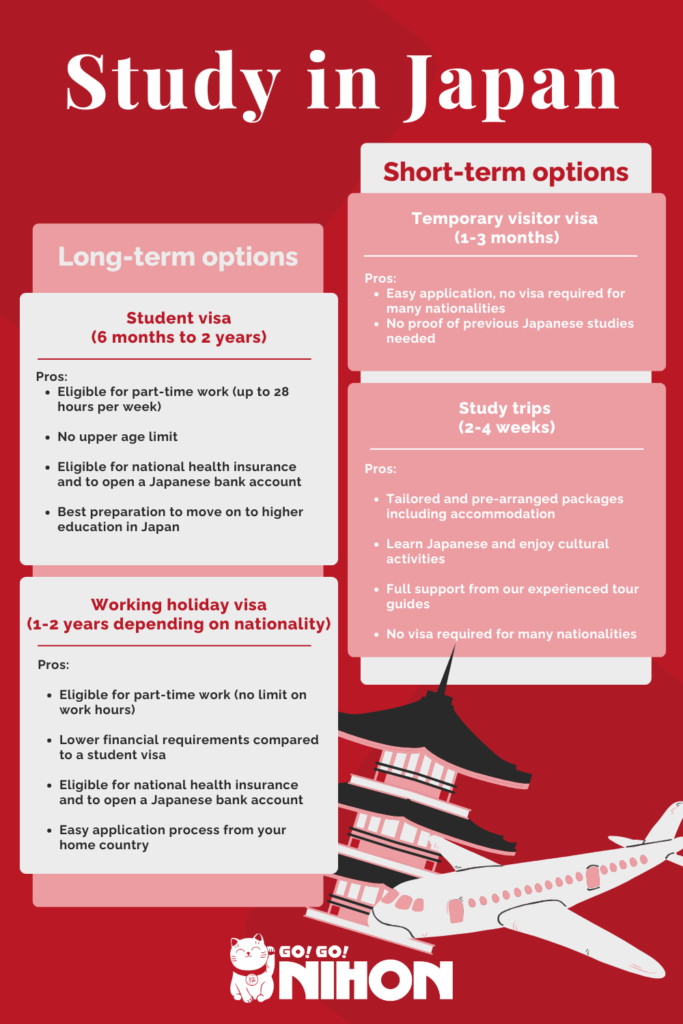
A student visa allows you to stay long term and comes with a lot of benefits, including permission to work part-time, get National Health Insurance, open a bank account, and more.
It’s important to note that applying for a student visa requires careful preparation. You’ll need to demonstrate clear study goals, provide the required documentation, and meet academic and financial requirements. While the process is more involved than short-term options, it’s well worth it if you want to improve your Japanese seriously and potentially live and work in Japan in the future.
Student visa for language school (six months – two years)
If you’re interested in learning Japanese and want the chance to immerse yourself in a new culture, then attending a language school will give you the chance to do both.
Language schools are located all across Japan, giving you the freedom to choose between vibrant city life or quieter regional areas. Most students study for six months up to two years, depending on their Japanese level, progress, and long-term goals.
Japanese language schools follow a structured curriculum and have clear expectations regarding attendance and academic performance. Consistent participation and progress are essential throughout your studies. Language schools generally have fixed intake periods, usually in January, April, July, and October (this can vary by school), so flexibility with start dates is limited compared to short-term programs.
Despite these requirements, language school remains one of the most flexible long-term options for studying abroad in Japan and is ideal for students who want to build a strong foundation in Japanese.
Student visa for university or vocational school (up to four years)
Another long-term option is studying at a Japanese university or vocational school.
University students can typically stay in Japan on a student visa for up to four years and three months, depending on their program. Vocational schools usually offer programs lasting between one and three years.
Studying at a higher education institution in Japan can better prepare you for working life in Japan, particularly if your goal is to secure full-time employment after graduation. Many graduates transition from a student visa to a work visa, especially if they build strong Japanese language skills during their studies.
Pros of a student visa
- Eligible for part-time work (up to 28 hours per week)
- Eligible for National Health Insurance
- Can open a Japanese bank account
- Wide range of housing options
- Better preparation for long-term life and employment in Japan
- Easier transition to a work visa after graduation
- Strong immersion environment for improving Japanese
- Go! Go! Nihon helps you with the involved application process
Cons
- Fixed start terms for language schools
- Application process requires advance planning and documentation
- University students must renew their visa periodically during long programs

Working Holiday visa (one month – one year)
Another way to study in Japan is through a Working Holiday visa, if your country has this agreement with Japan.
With a Working Holiday visa, you can study at a Japanese language school, but you cannot pursue a university degree. The visa is usually valid for up to one year, depending on your nationality.
Unlike a student visa, the Working Holiday visa allows you to work without hourly restrictions. However, the primary purpose of this visa is travel and cultural exchange. If you choose to spend a significant amount of time studying, you’ll have less flexibility for travel.
The Working Holiday visa is generally available only once per person, is limited to certain nationalities, and typically has an age restriction of 18–30 (some countries differ slightly). Check if you are eligible for the Working Holiday visa on the Ministry of Foreign Affairs website.
Pros
- No limit on working hours
- Eligible for National Health Insurance
- Can open a bank account
- Flexible lifestyle and work options
Cons
- Only available for certain nationalities
- Age restrictions apply
- Limited to one year
- Cannot be extended or re-used later
- Time spent studying reduces travel opportunities
Short-term options for studying in Japan
If you can’t commit to living in Japan for six months or longer, short-term study options are still available.
Short-term programs involve much less paperwork and offer flexible start dates. However, you cannot work on a short-term stay, and you are not eligible for National Health Insurance, so private travel insurance is required.
These options are best for people who want a taste of life in Japan or to supplement existing Japanese studies.
Temporary visitor visa (one month – three months)
You can study short term at selected Japanese language schools on a temporary visitor status. Not all schools offer this option, so availability is limited.
This is a great way to combine sightseeing with structured Japanese study, especially if you’re visiting Japan for the first time.
Pros
- Simple application process
- Flexible start dates
- No long-term commitment
Cons
- No part-time work allowed
- No National Health Insurance
- Limited school choices
- Short duration limits language progress

Study Trip (two – four weeks)
Another short-term option is joining one of Go! Go! Nihon’s Study Trips.
These are pre-arranged programs that combine Japanese language lessons with cultural activities and travel. Programs range from two to four weeks, depending on the trip.
Simply choose a trip, book your flight, and Go! Go! Nihon will handle the rest.
Pros
- Smooth and simple application
- Pre-arranged, stress-free experience
- Cultural activities included alongside language study
Cons
- Less flexibility than independent travel
- Not long enough to see major language improvement
Application deadlines
Go! Go! Nihon has over 15 years of experience helping people study and live in Japan. We support you with school selection, housing options, and guide you through every step of the application process — completely free of charge. If you’re considering a student visa, we recommend contacting us six months to one year in advance to ensure you have enough time to prepare documents and meet application deadlines.
If you are interested in knowing more about life in Japan, check out our blog for regular updates, and if you are thinking about moving to Japan, contact us for more information.