Skip to content

Language schools in Japan, and especially in Tokyo, bring a diverse crowd of students together from around the world, all with the shared goal of learning Japanese. At Japanese language schools, classes are taught in a fully immersive experience, in order for students to pick up the language faster and be able to communicate with each other.
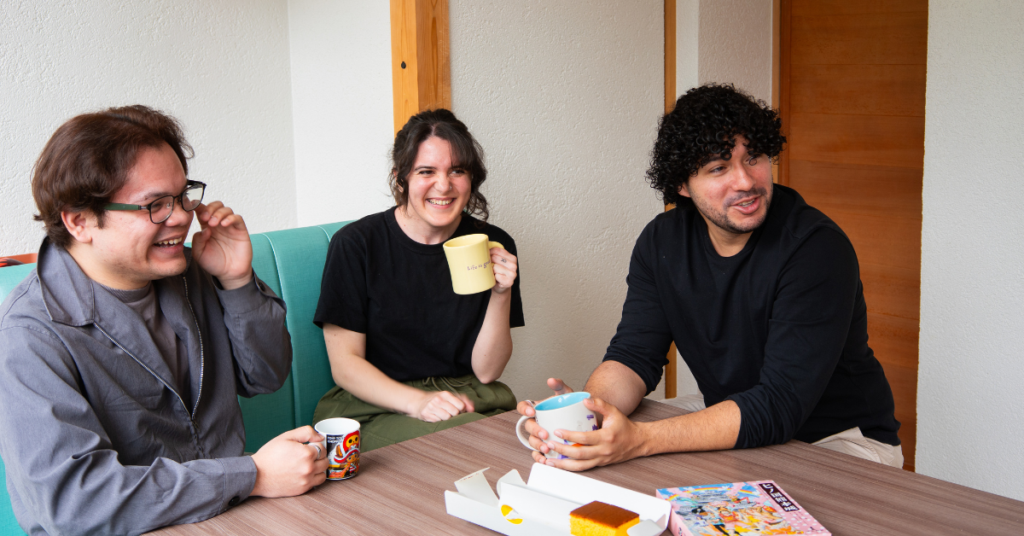
Shinjuku Japanese Language Institute, also known as SNG, has over 50 years of experience teaching the Japanese language through their own original teaching method, known as the “Ezoe Method.” This innovative and creative teaching strategy has proven both popular and effective in helping students acquire the language skills they need and the ability to express themselves in Japanese. To see what it’s really like to study here, we sat down with three current students at different stages of their language journeys:
- Katelyn, an American student from Seattle who has been studying in the beginner class for about four months.
- Rodrigo, a Mexican student who has been at SNG for a year and two months.
- Alex, a Brazilian student who has spent the last year and nine months learning Japanese at SNG.
Why did you choose SNG?
When deciding where to study in Tokyo, all three students were drawn to SNG’s distinct reputation and specialized learning method.
For Katelyn, the school’s unique accessibility features stood out right away:
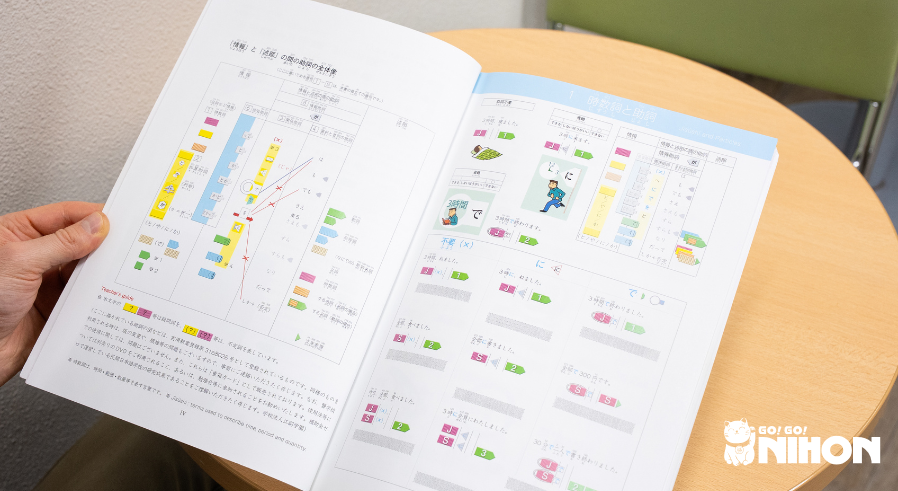
“I noticed the method was prominently displayed on the website. Everything’s color coded, and they’ve been using this teaching style for about the last 50 years … The method also has a bunch of lines in the different cards so that if some students aren’t able to see colors — maybe they’re colorblind — they can still distinguish which ones are able to be different parts of sentences. So it’s really inclusive for everybody.”
Rodrigo was looking for a program that would maximize his foundational learning, noting:
“When I encountered SNG, I saw its location, the programs, and the Ezoe Method that they offered, and the method really caught my attention. When I started studying here, I realized that it actually was even better than I thought, because it helped you a lot to establish the basis of the language.”
Alex actually discovered the school through Go! Go! Nihon, keeping his eye out for an approachable starting point:
“I saw that the school has the Ezoe Method, which is very beginner-friendly. That caught my interest, which is why I chose it.”
What’s your typical day like?
Lessons
A student’s daily schedule is tailored to keep them engaged without burning out, running for roughly four hours a day with strategic breaks. Katelyn takes afternoon classes from 1:30 to 5:30 PM, noting that they get “three ten-minute breaks in between to give us a chance to go to the bathroom or grab a snack.” Alex, on the other hand, takes morning classes from 9:10 AM to 12:40 PM before heading off to a part-time job from 2:00 or 3:00 PM until 7:00 PM.
The structure of the daily lessons intentionally shifts depending on your level:
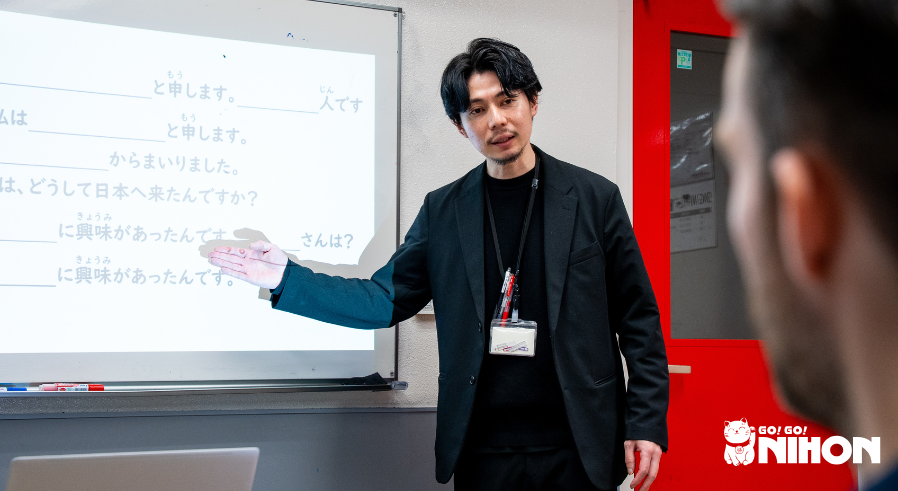
- The Ezoe Method: This original system breaks the Japanese language down visually piece by piece. Katelyn compares it to “playing with Legos because you’re taking each individual piece … and then you put them together to form sentences.” Rodrigo explains that while beginners rely heavily on these tactile visual cards to learn sentence structure, as you transition into jokyu (advanced level), “those cards disappear because you are intended to already know how Japanese works so we focus more on the utility of the actual grammar.”
- Drills and repetition: In the beginner levels, lessons focus heavily on building confidence. Katelyn shares that her teachers “will always give the answer and then ask the students to repeat it … there’s a lot of drill work because it gets you to just automatically respond.” Alex echoes this, adding that “in the beginner class, we do a lot of repetition because we don’t know how to pronounce the words yet.”
- Advanced complexity: As students move up, the curriculum shifts. Rodrigo notes that his advanced classes focus on multi-layered skill integration, tackling “complex subjects, from politics to science.” Alex adds that the advanced tier also shifts to help “prepare you for the JLPT.”
Classes
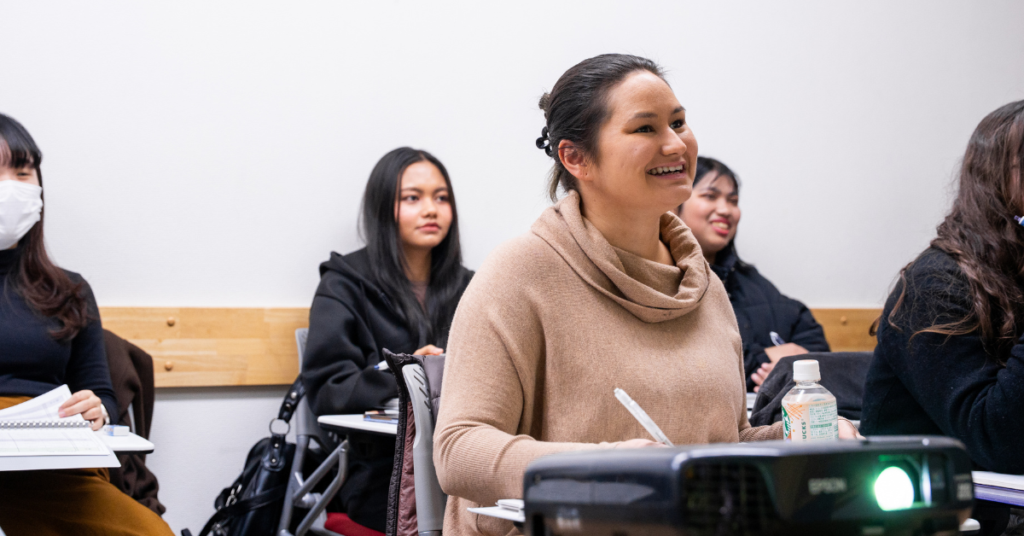
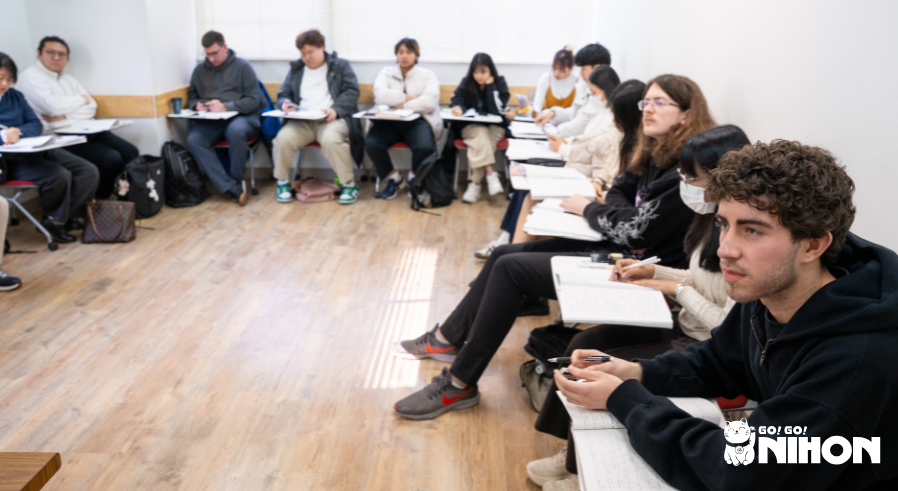
The dynamic within the classrooms is highly interactive and intimate. Katelyn’s class sits at around 16 students, which she prefers over massive university lecture halls because “it’s just so much more intimate that you really get a chance to make friends.” Alex’s class maintains a similar size of about 15 people. For Rodrigo, watching the class sizes naturally shrink from 20 down to 12 as he reached Advanced 3 allowed for a deeply focused, collaborative environment where the pace feels perfectly balanced: “You do the progression really slowly, so you don’t really feel the intense level getting higher and higher.”
Classmates
SNG acts as a miniature global community. Katelyn enjoys interacting with classmates from Italy, France, Myanmar, Bangladesh, and Nepal, noting that “it’s really cool to see all the different cultures.” Alex emphasizes that studying in an international environment alongside students from Taiwan, Spain, and Malaysia completely shifted his perspective: “After I came here, this actually was the first time I got to meet people from other countries … it’s pretty good for the mindset.” Rodrigo points out that this mix of backgrounds forces everyone to use Japanese as their bridge language, which expands your cultural horizons in a way “that not every school has.”
Location
Situated in the popular student hub of Takadanobaba, Shinjuku, the campus location earns high praise. Alex highlights that “this area has a lot of colleges and universities … it’s a very nice environment to study in.” The campus itself spans three closely situated buildings featuring student lounges, a kitchen, and a quiet annex library for independent study.
The neighborhood is incredibly well-connected, sitting just a 5- to 10-minute walk from the train station. Katelyn loves the convenience, sharing that “a couple of my friends and I have gone out afterwards, either to go get something to eat or sometimes we’ve gone to play games together,” while utilizing the nearby lines to easily explore Ikebukuro, Shinjuku, and Shibuya.

What are the highlights of SNG?
How has your Japanese improved?
Living and studying in Tokyo has supercharged everyone’s language progress. Katelyn remarks that speaking with her classmates daily has put her Japanese “almost on autopilot,” allowing her to easily navigate convenience stores and cafes completely on her own. Alex notes that his speaking and listening skills “got better really fast,” giving him the tools to communicate naturally with coworkers at his part-time job and make local Japanese friends. Rodrigo, who started out barely understanding a word his teachers said, now feels fully fluent: “My Japanese improved way, way, way faster than I ever thought. I feel prepared right now to face a Japanese university that teaches in actual Japanese.”
What are SNG’s strong points?
When asked what makes SNG truly special, the answers pointed directly to the community and resources:
- The people: Katelyn notes that “all of the students really want to learn, and the teachers really want to teach … you can feel that when you walk into the classroom.” Alex adds simply that the strongest point is the people, as the supportive staff, friends, and teachers “make it very easy to learn the language.”
- Specialized curriculums: Rodrigo highly values SNG’s advanced elective tracks, including specialized preparatory courses for the EJU (Examination for Japanese University Admission) covering math, physics, and chemistry, alongside dedicated Business Japanese classes that teach keigo (formal Japanese).
What services does SNG provide?
Navigating life in a brand-new country can be overwhelming, but SNG’s front office staff acts as a vital safety net.
- Job search: The school provides immediate support for finding part-time work. Katelyn explains that right from orientation, students receive QR codes to an online message board displaying targeted job postings for every language level. Alex adds that the school actively helps students format their Japanese resumes (rirekisho) and find work, which he highly recommends since a part-time job teaches you formal workplace Japanese and embeds you into the local culture.
- Events: SNG coordinates regular cultural field trips (bunka kenshu). Rodrigo has visited Asakusa, the Museum of History, the Museum of Science, Nikko, and even the Japanese Parliament. The school also hosts voluntary events, such as local park volunteering — which Katelyn participated in — and community gardening initiatives, alongside popular “free talk” mixer events with Japanese university students from Waseda University over holiday breaks.
- Daily life assistance: For personal administration, Katelyn credits the front office for helping her survive her first few months: “They’ve helped me open a bank account. They helped me get a phone number. They also helped me register my address with the city office, and they helped me read my mail. I feel like I have a really strong support system.” Rodrigo agrees, noting that the school perfectly guided him through managing local town rules, city taxes, and health insurance when he first arrived from Mexico.

What are your plans for the future?
The time spent at SNG is setting up all three students for major long-term success in Japan. Katelyn, who earned an undergraduate degree in Japanese literature back in the US, plans to leverage her fluent reading skills to pursue a master’s degree at a Japanese university. Rodrigo feels fully equipped to take on an engineering degree taught entirely in Japanese, stating, “the school has really helped me a lot to gain confidence.” Meanwhile, Alex is currently utilizing the school’s administrative guidance to apply for Technical College San Marco in Japan with the ultimate goal of living in the country long term.
For anyone hesitant about taking the leap, the students have a final piece of advice:
Alex: “The most difficult part of coming to Japan is actually before coming to Japan — the fear of leaving your family and your country. Fear was the only wall that I had, and after breaking that, I feel my opportunities were very, very good.”
Rodrigo: “If you decide to come, don’t be afraid and definitely go for it. Come here, study hard, and just work hard for your dreams. As we say here: isshooni ganbarimashou (Let’s do our best together)!”
Katelyn: “It can be scary moving to a new country. However, coming to SNG would be a really good choice. As long as you come to class every day, you will learn. If you can be okay with 1% improvements — maybe it doesn’t feel like you’re really improving — but I promise it makes a really big difference.”
To learn more about studying Japanese in Japan, make sure to check out our blog. Interested in learning more about the different language schools available to you? Contact us and one of our student advisors will be happy to help you.