Skip to content


We asked language school students at a recent Go! Go! Nihon welcome event about their goals for studying in Japan, and we received a plethora of different answers. Some are chasing a specific career, like pastry arts or translation, while others just want to feel less lost at a convenience store. A few are already looking to the future, at graduate school or a life in Japan beyond language school. Here’s what they told us.

A pastry chef chasing match and mochi: Andrea, Madrid, Spain
Andrea is already a pastry chef back home, and she’s come to Japan to bring that skill into a new kitchen. “I want to work here, I am a pastry chef. I love Japanese sweets. I would like to get a job first, and if I can I want to open my own bakery,” she said. For now, she’s thinking about starting out at a hotel, to get a feel for how people work here, before striking out on her own.
Andrea loves classic Japanese pastries, and the ones sold at festivals too, along with the ingredients that go into them. “They have ingredients here that they don’t have in Europe — well, now they have them, but not on the same level,” she said. She’s already experimenting at home, even without proper equipment. “Right now I don’t have the equipment, but I did a lot of experimenting, yeah,” she said.
Vocab from Andrea’s interview:
- パティシエ (patishie) — pastry chef
- お祭り (omatsuri) — festival
- 試す (tamesu) — to try, to experiment

Learning Japanese and learning about the world: Brianna, Orlando, Florida, USA
For Brianna, this was already her third trip to Japan — and she’s hoping this one turns into something longer. “I wanted to live abroad for a little bit because I’ve never lived abroad in my life,” she said. She’s planning to stay for a year, though she’s wondering if it’ll end up being longer. “I’m planning for a year, but I’m scared I’m going to fall in love with the city [of Tokyo],” she said.
One thing that’s already struck her is how international her language school experience has been. “I have met people from so many different places. It’s so fun being in another culture, I feel like I’m learning about the whole world,” she said. “It’s kind of like a hub, where everyone wants to come here.”
Her long-term goal centers on the language itself — not just speaking it, but really connecting with people through it. “I’m excited to be able to actually talk to Japanese people and actually have full conversations, and not force anyone to speak English,” she said.
Vocab from Brianna’s interview:
- 海外 (kaigai) — abroad, overseas
- 交流 (kōryū) — exchange, interaction
- 直接 (chokusetsu) — directly

New to Japan, ready for anything: Jake, Dublin, Ireland
Jake was the only student we spoke to on his very first trip to Japan, and just four days in, he was still finding his footing. “I’m pretty excited. I’m also a bit nervous — there’s a bit of a language barrier there,” he said.
His goals, though, were already clear. “The original reason that I wanted to come was to have a new life experience, meet new people, become fluent in the language, and be able to speak to Japanese people,” Jake said. “And yeah, maybe potentially work here and live here in the future.”
Vocab from Jake’s interview:
- 緊張する (kinchō suru) — to feel nervous
- ペラペラ (perapera) — fluent, fluently
- 経験 (keiken) — experience
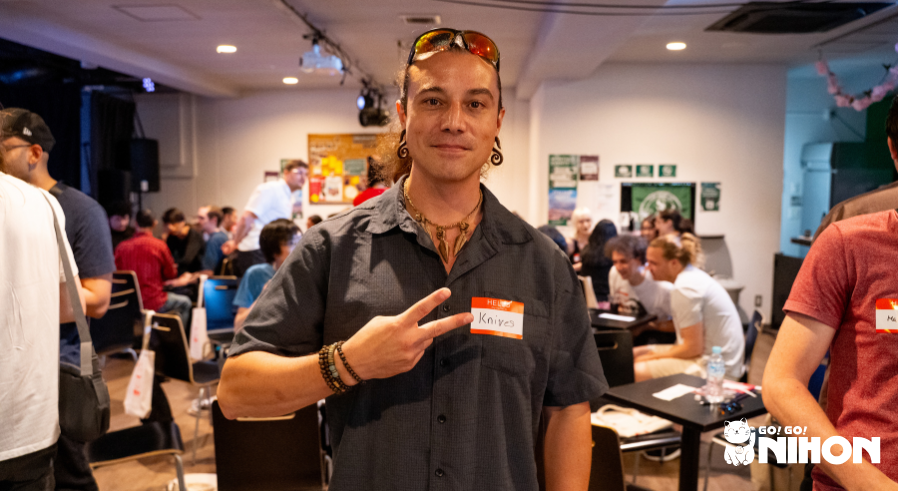
Chasing the culture: Knives, Hawaiʻi, USA
On his second trip to Japan, Knives’ motivation was less about a single career goal and more about total immersion. “I love the culture, I love the food. I think the nature and the scenery and the aesthetic is just so amazing,” he said.
His plan for this stay is to soak up as much as possible, without necessarily locking in a fixed timeline. “My long-term plan, I guess, would be to just really immerse myself in the culture and see as much as possible, take it all in,” he said. “Who knows how long I’ll actually be able to stay, so I’m going to experience as much as possible.”
Vocab from Knives’ interview:
- 文化 (bunka) — culture
- 景色 (keshiki) — scenery
- 没頭する (bottō suru) — to immerse oneself
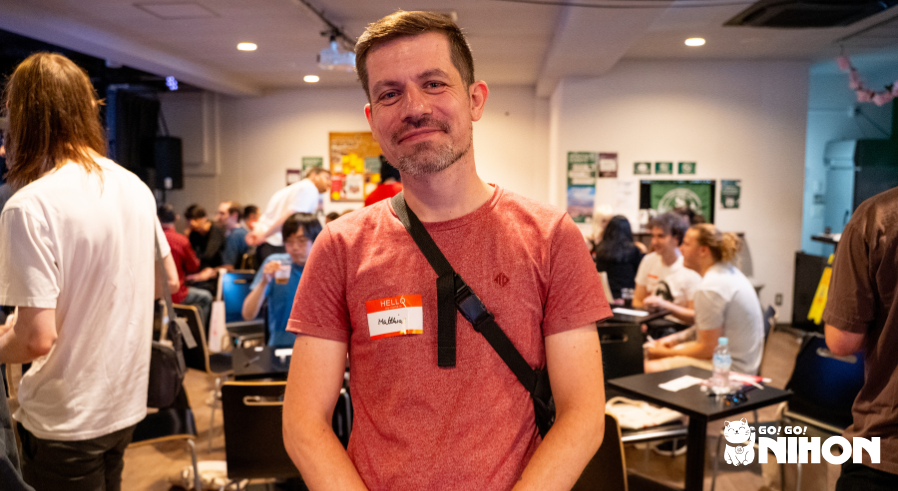
Ten trips in, still learning: Matthias, Germany
Matthias has visited Japan nine times before — this trip makes ten — but this is the first time he’s come specifically to study the language. “I’ve been fascinated with Japan for a long time. However, I’m still not able to communicate the proper way, and that’s what I’d like to change,” he said.
His goal is fluency he can actually use: talking with the Japanese people around him without the gaps he’s felt on past visits. And if things go well, he’s open to staying longer-term. “If it’s possible, I’d like to stay here,” he said.
Vocab from Matthias’ interview:
- 魅了される (miryō sareru) — to be fascinated
- 会話 (kaiwa) — conversation
- 正しい (tadashii) — correct, proper

A long-time dream, put to the test: Alessio, Lecce, Italy
Alessio had wanted to visit Japan for years — to learn more about the culture and learn the language. He wants to understand the reality of living here versus the dream of visiting Japan as a visitor, not a resident. “I always had this dream to come here,” he said.
“It’s one thing to dream of living here and another to actually live the reality, so I really want to spend my time here understanding what it’s like actually living in Tokyo,” Alessio said. His goal for this stay is simple: experience day-to-day life as a resident rather than a tourist, and use that experience to decide whether he wants to make a longer move in the future.
Vocab from Alessio’s interview:
- 夢 (yume) — dream
- 住む (sumu) — to live, to reside
- 決める (kimeru) — to decide

Building toward a master’s and a career in translation: Alessandro, Bari, Italy
Alessandro came in with a clear academic and career plan. His first goal for his time in Japan is to build a strong, basic foundation in the language. From there, his sights are set further ahead: after finishing his bachelor’s degree, he wants to pursue a master’s degree in Japan.
“I want to reach a strong N3 level and then do a master’s here. My biggest goal is to translate video games and manga while also doing marketing,” Alessandro said.
Vocab from Alessandro’s interview:
- 基礎 (kiso) — basics, foundation
- 大学院 (daigakuin) — graduate school
- 翻訳家 (hon’yakuka) — translator
FAQ
- What do language school students hope to achieve while studying Japanese in Japan?
Goals vary widely. Some students are working toward a specific career, like translation, pastry arts, or hospitality. Others are focused on personal growth, cultural immersion, or simply feeling confident enough to handle everyday conversations. Many students’ goals shift or sharpen once they’re actually living in Japan.
- Do language school students plan to work in Japan after their studies?
Some do. A few students we spoke to mentioned wanting to find a job in Japan after language school, whether short term to gain experience or as part of a longer-term plan to live in the country. Others are focused on returning home or moving on to university.
- How long do students typically stay at a language school?
It depends on the student and their visa, but many students find that a longer program, like a two-year course, gives them more room to build real fluency instead of just getting by. Shorter stays are possible too, and some students extend their plans once they arrive, depending on how their studies and life in Japan are going.
- Does a student need to already speak Japanese to attend a language school in Japan?
Yes, at least some. Immigration requirements have changed, and student visa applicants now need to show a baseline level of Japanese, which can be proven through an interview and assessment as part of the application process. Once enrolled, schools place students by level, from that baseline up through more advanced classes.
Ready to start your own Japan story?
Every student who spoke with us started in the same place: choosing a language school and making the decision to come to Japan. Go! Go! Nihon offers free support to help you find the right school and prepare for your move, wherever your goals take you next.
Make sure to check out the blog to learn more about language schools, moving to Japan, and learning Japanese.