
Guide to Schools in Japan for International Students
This guide details how to study abroad in Japan for foreign students, including processes, visas, costs, top destinations, and expert tips. Discover more.
 Skip to content
Home • Studying Abroad in Japan • Schools in Japan • English-Taught Universities
Start your Japanese degree immediately with English-taught programs.

English-taught programs in Japan offer a direct pathway to obtaining a student visa, allowing you to begin your academic journey straight away, even if you don’t yet speak Japanese. These degrees are internationally recognised, tuition fees are often more affordable than in other major study destinations, and many programs are designed with strong career outcomes in mind.
Japan is also becoming an increasingly popular destination for international students, with 336,708 choosing to study there in 2024. This growth reflects a broader national effort to welcome global talent and create more accessible pathways into higher education and employment.
If you are mapping out your study plan, our comprehensive schools in Japan for international students roadmap lays out every option, while our main guide on studying abroad in Japan provides foundational relocation guidance.
Table: This comparison summarizes the 2024 and 2025 career outcomes and institutional focus for our four partner universities. All data points reflect the most recent official reports for international students and graduates.
Feature | Academic Focus | Employment Rate | Salary/Promotion |
Ritsumeikan APU | Multicultural Leadership & Global Business | 330 International students secured job offers in 2024 | Ranked 2025 Employers’ Choice of University |
GLOBIS University | Practical Business (MBA) & Entrepreneurship | 65.7% (within 3 months) / 75% stay in Japan | 18% average salary increase by graduation |
Eikei University | Social System Design & Liberal Arts | 91.7% (of job-seeking applicants) | Focus on startup and global company entry |
Hosei University | Traditional Liberal Arts | 86.1% overall (94.1% for Graduate students) | High stability; rates rose from 83.7% in 2023 |
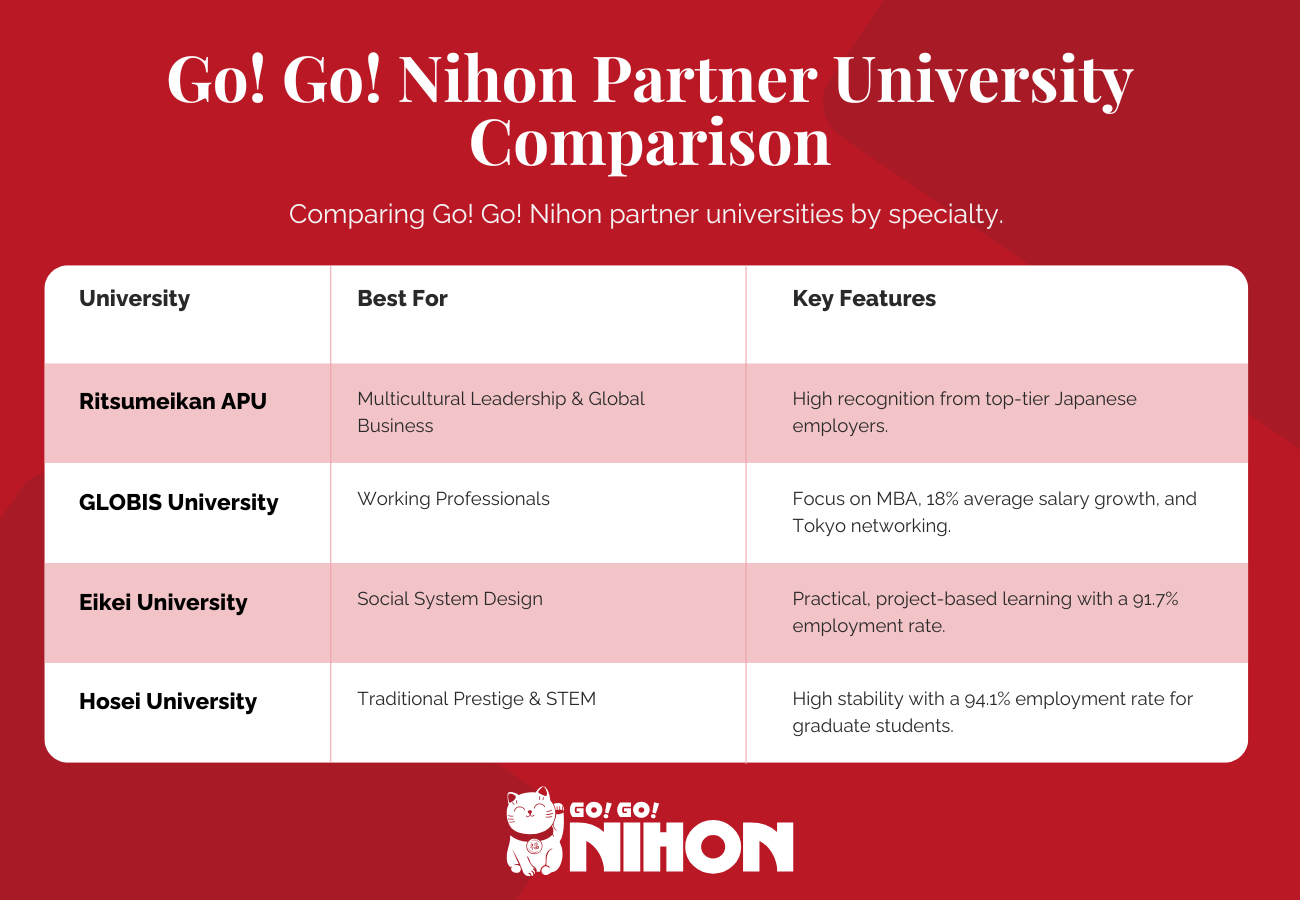
We partner with prestigious institutions, such as Hosei University, Ritsumeikan APU, and GLOBIS, which offer specialized English-taught programs in business, social sciences, and sustainability.
Hosei University is one of Japan’s oldest and most prestigious private institutions, known for its commitment to global engagement and practical education. The university consistently produces high employment outcomes for its international student body across both undergraduate and graduate levels.
Source: Employment Status of International Students (3 Years)
Ristumeikan Asia Pacific University (APU) is a premier destination for multicultural education, with a student body representing over 100 countries and a nearly 1 to 1 ratio of domestic to international students. The university is specifically designed to produce graduates who can thrive in global business and social innovation.
Source: Job Placement and Advancement – Ritsumeikan Asia Pacific University
GLOBIS is Japan’s largest business school, offering a practical, network-heavy MBA in the heart of Tokyo. The program is designed for professionals who want to accelerate their careers in the Japanese business ecosystem.
Eikei University focuses on “Social System Design,” using a practical, project-based curriculum to prepare students for the global labor market. The university incorporates hands-on experience directly into its degree programs, requiring all students to complete at least two internships or volunteer placements with real-world organizations.
Integrated Liberal Arts Education: By merging humanities and sciences, the curriculum nurtures the specific interests of each student over four years of study. This results in career outcomes that reflect both individual professional goals and the diverse needs of different industries and regions.
University | Best For |
Ritsumeikan APU | Students seeking a truly global environment and high recognition from top-tier Japanese employers. |
GLOBIS University | Working professionals aiming for an immediate salary jump and leadership transitions within the Tokyo business ecosystem. |
Eikei University of Hiroshima | Undergraduates who want hands-on, project-based learning and guaranteed internship experience. |
Hosei University | Students looking for the prestige of a traditional private university with specialized success in STEM and science-related graduate roles. |
Tuition at Japanese universities is significantly lower than in the US or UK, with private institution fees often ranging between ¥1.4 million and ¥1.6 million per year.
Important: Please note that Go! Go! Nihon does not provide application support for scholarships or financial aid programs. You must apply for these opportunities directly through the university or the providing organization.
University | Yearly Tuition (approx.) | Scholarship Opportunities |
Hosei University | ¥1,450,000 | 50% Tuition Reduction |
Ritsumeikan APU | ¥1,512,740 | 30%–100% Tuition reduction |
GLOBIS (MBA) | ¥3,845,000 (Total) | Available Financial Aid |
Eikei University of Hiroshima | ¥952,260 | 50% Tuition Waiver and grant-based scholarships |
For families used to the high costs of US or UK systems, these rates represent exceptional value, especially when combined with a clear pathway to a work visa.
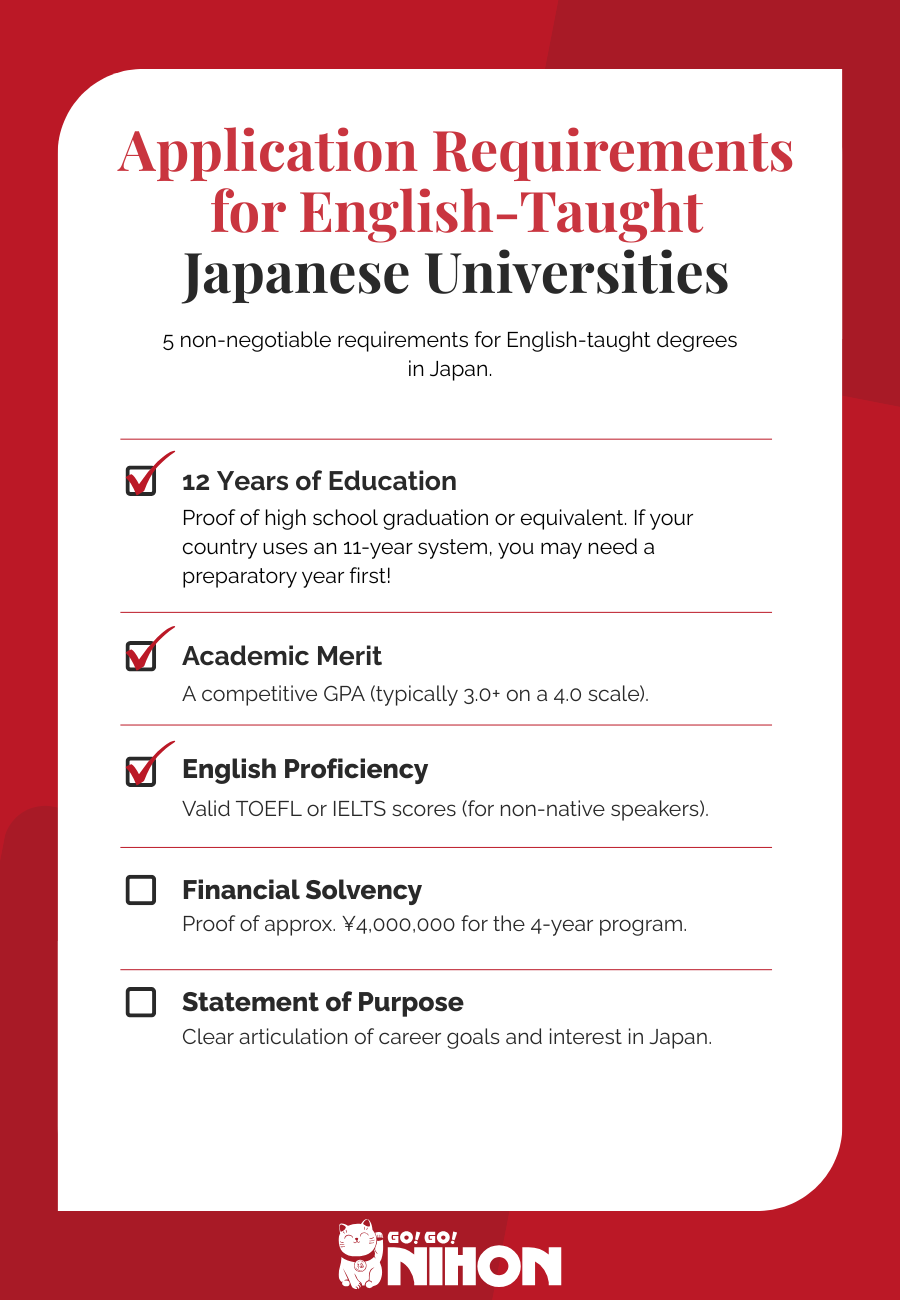
Applying to a Japanese university requires meeting a strict baseline of 12 years of formal education, proving financial stability, and providing English qualifications if you are from a non-native English speaking country.
Top universities in Japan like Hosei University, Ritsumeikan Asia Pacific University (APU), and Eikei University of Hiroshima use a holistic review process to confirm that applicants are prepared for the academic and cultural demands of studying in Japan.
The table below summarizes the core entry criteria for a student visa and school placement at Japanese language schools, vocational or trade schools, and universities. More detailed descriptions follow.
Requirement Category | Specific Criteria | Essential Documentation |
Basic Education | Completion of 12 years of formal schooling | High school diploma or graduation certificate |
Academic Merit | Competitive grades, typically a minimum 3.0 GPA | Academic transcripts and SAT, ACT, or IB scores |
English Proficiency | Required for students from non-native English speaking countries | Official TOEFL or IELTS scores |
Japanese Proficiency (for Japanese-Taught Programs) | JLPT N2 level | |
Financial Solvency | ¥4 million for the 4-year program | Bank balance certificates (3-year history may be required) |
Holistic Assessment | Clear articulation of career goals and interest in Japan | Statement of Purpose and letters of recommendation |
DID YOU KNOW?
If your home country uses an 11-year education system, you are not immediately disqualified. You may simply need to complete a designated university preparatory course to meet the 12-year requirement before you submit your final application.
To be admitted into any Japanese university, you must meet specific educational and linguistic benchmarks:
DID YOU KNOW?
Because of the high language barrier for Japanese-track degrees, many international students spend 1 to 2 years at a Japanese language school first to bridge the gap and prepare for the EJU.
The university admissions process in Japan for English-taught programs is highly holistic, meaning officials look at more than just your grades. You will be required to submit academic transcripts, letters of recommendation, and a meticulous Statement of Purpose.
Immigration and university officials heavily scrutinize this statement. It must clearly articulate why you chose Japan over other countries, how the specific institution aligns with your long-term career goals, and your intentions for staying in the Japanese workforce after graduation.
Proving that you can afford to live and study in Japan is one of the most rigorously vetted parts of the process.
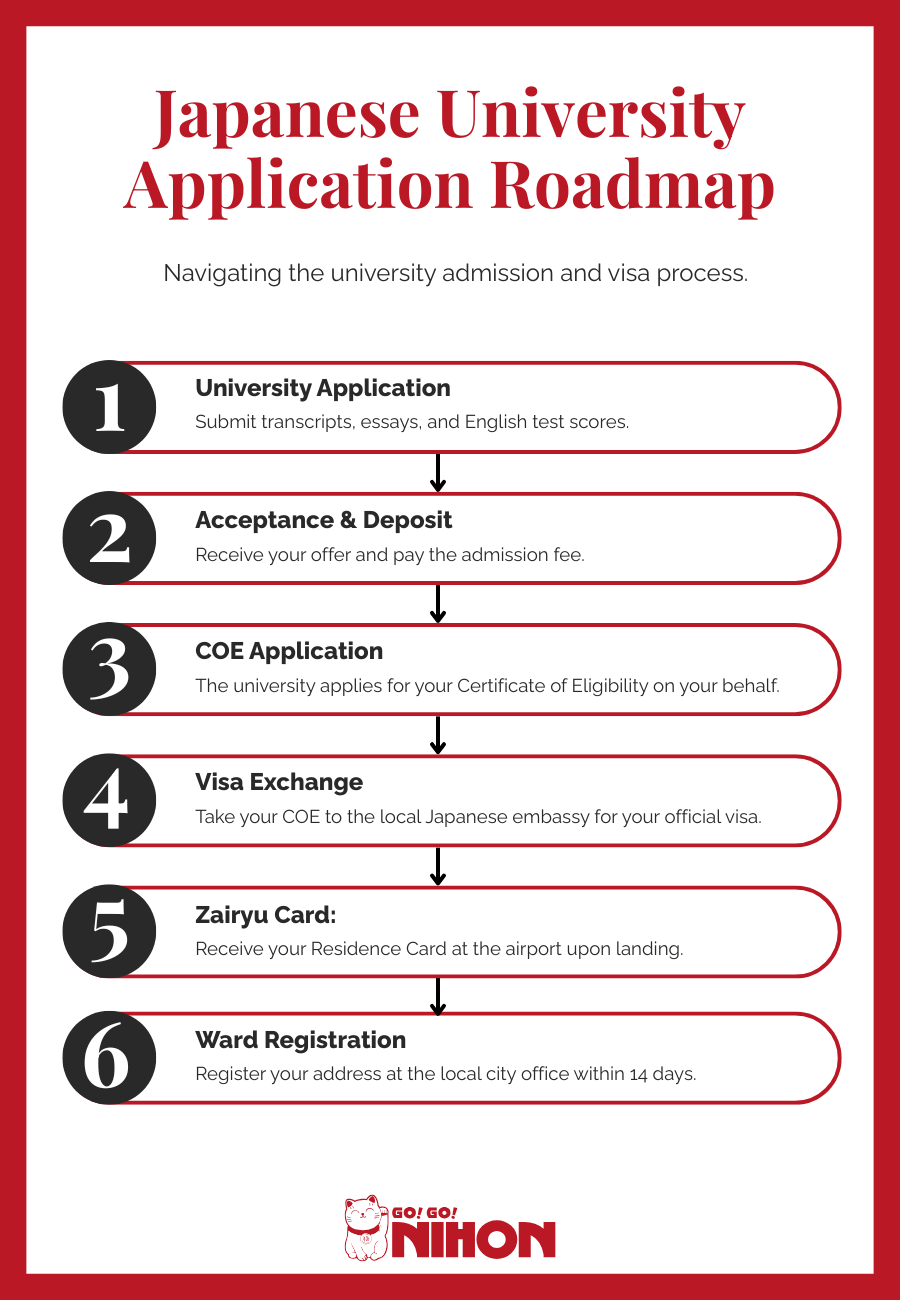
Once a university accepts your application, you must navigate a multi-step bureaucratic process to enter the country.
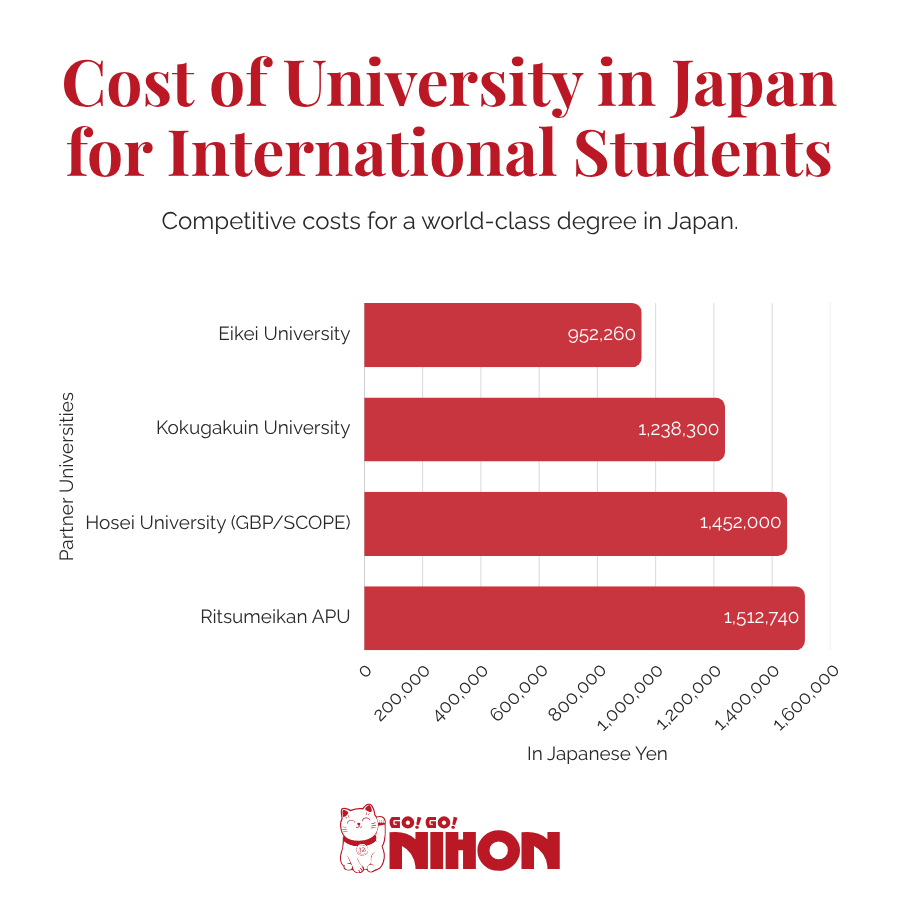
University tuition in Japan is highly competitive, with total first-year costs at prestigious institutions typically ranging from ¥950,000 to ¥1.6 million, a fraction of the price of equivalent degrees in the US or UK.
For students used to the high costs of Western higher education, Japan offers an exceptional return on investment. Below is a detailed breakdown of the total first-year fees at our partner universities, including application fees, admission fees, and annual tuition.
University / Program | Total 1st Year Cost | Key Fee Breakdown |
¥952,260 | Admission: ¥394,800; Tuition: ¥535,800 | |
Hosei University (IGESS) | ¥1,450,000 | Admission: ¥240,000; Tuition: ¥968,000 |
Hosei University (GBP & SCOPE) | ¥1,452,000 | Admission: ¥240,000; Tuition: ¥968,000 |
Hosei University (GIS) | ¥1,582,000 | Admission: ¥240,000; Tuition: ¥1,097,000 |
¥1,512,740 | Admission: ¥200,000; Tuition: ¥1,300,000 | |
¥1,238,300 – ¥1,319,300 | Fees vary by faculty; Admission: ¥240,000 | |
GLOBIS University (1-Year MBA) | ¥4,095,000 | Total program cost (enrollment + tuition) |
While the initial investment for the first year includes a one-time admission fee, you should plan for recurring costs in your second year and beyond:
A degree from a Japanese university provides a unique combination of financial value, global prestige, and a direct path to the highest student-to-work visa conversion rate in the developed world.
Choosing to study abroad in Japan is a strategic move for students who want to build a high-ROI career without the high debt levels often associated with Western higher education. The Japanese government’s focus on integrating global talent means that your academic success translates directly into long-term career goals and professional stability.
Key advantages for international students include:
DID YOU KNOW?
International students in Japan can apply for the MEXT scholarship, one of the world's most generous aid packages, which can provide a "full ride" covering your tuition, monthly stipend, and round-trip airfare. Go! Go! Nihon does not offer MEXT scholarship application support.
Universities in Japan that teach in English provide a strategic, high-ROI pathway to academic success and long-term career stability within the Japanese workforce.
Enrolling in an English-taught program allows you to start your degree immediately and enter a workforce with record-high employment rates for new graduates. These institutions offer significantly lower tuition than Western counterparts, combined with the unique professional asset of cross-cultural resilience.
Applying to a Japanese university in a foreign country is a complex process, but our team at Go! Go! Nihon provides free, expert support to help you move to Japan with confidence. Contact Go! Go! Nihon for free university placement support.
Explore all your academic options and view our full list of partner universities.
This guide details how to study abroad in Japan for foreign students, including processes, visas, costs, top destinations, and expert tips. Discover more.

This guide details how to study abroad in Japan for foreign students, including processes, visas, costs, top destinations, and expert tips. Discover more.

This guide details how to study abroad in Japan for foreign students, including processes, visas, costs, top destinations, and expert tips. Discover more.

This guide details how to study abroad in Japan for foreign students, including processes, visas, costs, top destinations, and expert tips. Discover more.

This guide details how to study abroad in Japan for foreign students, including processes, visas, costs, top destinations, and expert tips. Discover more.