Skip to content

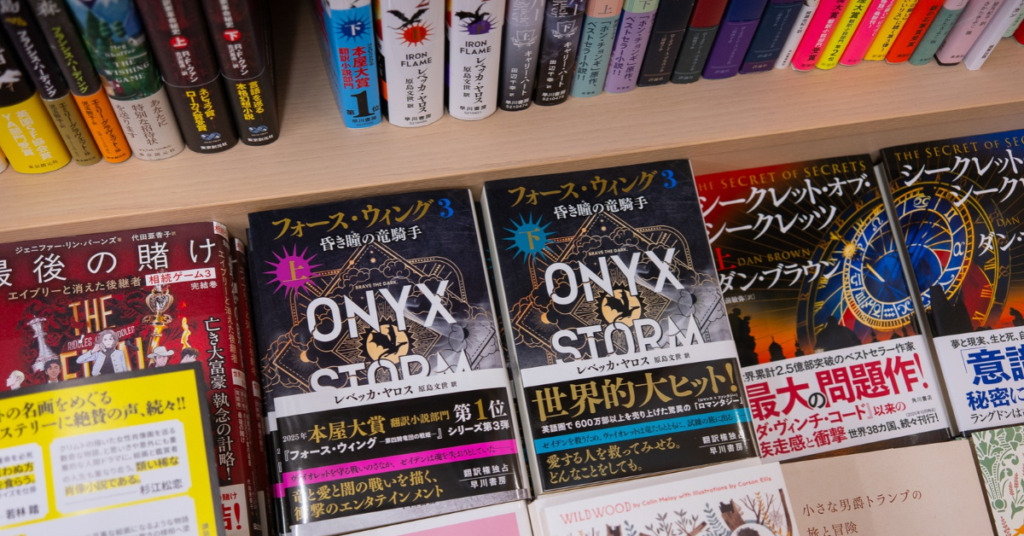
Reading in Japanese is one of the best ways to make your studying feel real. But picking a first book can be tough, especially when you’re not sure if it’s too hard. So our team headed to a bookstore in Japan and took photos of books we think Japanese learners will enjoy, like absolute beginner picks and a big romantasy novel for advanced readers.
Below, you’ll find a quick guide to each JLPT level and the books we picked for each one.
In summary
- We picked eight books, from N5 to N1.
- Start with picture books and illustrated books at N5 and N4. They’re the easiest way to build reading confidence.
- Books you already know in your own language, like “Harry Potter” and “The Little Prince,” are much easier to read in Japanese because you know the story.
- The levels below are our team’s best estimates. The JLPT doesn’t give official levels for books, so use them as a guide, not a rule.
What each JLPT level means for reading
The numbers here are rough figures that are commonly cited. The JLPT doesn’t publish official kanji or vocabulary lists, so treat them as a general idea. The numbers are totals, so N3 includes what you learned at N5 and N4.
| Level | Rough kanji | Rough vocabulary | What it means in practice | Book from our list |
| N5 | about 100 | about 800 words | You can read hiragana, katakana and a few basic kanji, plus short, simple sentences about everyday topics. | “The Boy, the Mole, the Fox and the Horse” |
| N4 | about 300 | about 1,500 words | You can follow simple everyday texts and short stories, especially with furigana. | ようかいのずかん (N5 to N4) |
| N3 | about 650 | about 3,750 words | You can handle everyday Japanese at a more natural pace. This is the bridge between beginner and advanced. | “The Little Prince,” “Kiki’s Delivery Service,” “Convenience Store Woman” |
| N2 | about 1,000 | about 6,000 words | You can read newspapers, magazines and many novels, and follow most everyday and work topics. | “Harry Potter,” “Your Name” |
| N1 | about 2,000 | about 10,000 words | You can understand complex, abstract and specialized writing, including long novels. | “Fourth Wing” |
N5: your first book
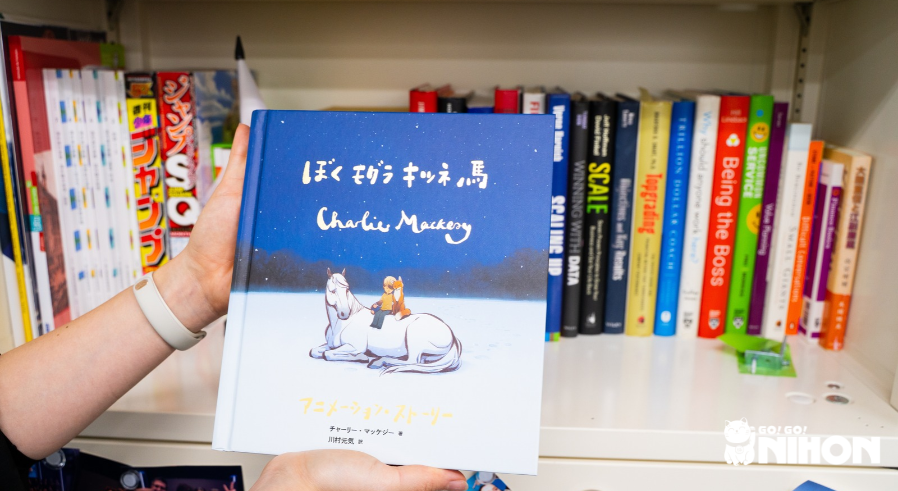
ぼく モグラ キツネ 馬 (“The Boy, the Mole, the Fox and the Horse”)
Charlie Mackesy’s gentle, illustrated book is told in short lines with lots of space on every page. That makes it a calm, low-pressure first read. If you’ve seen the English version, you’ll recognize the story and the drawings, so you can focus on the Japanese.
Level: N5
N4: a picture book with a fun topic
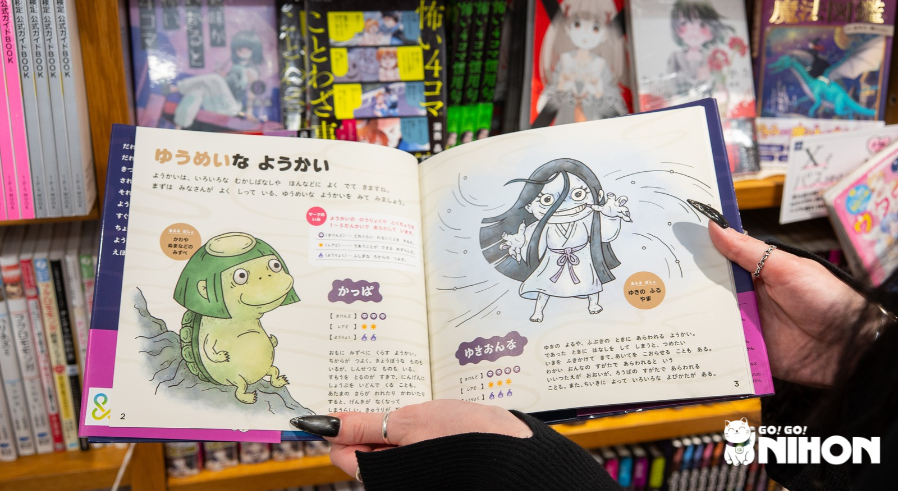
ようかいのずかん
This picture encyclopedia from Gakken introduces yōkai, the spirits and creatures from Japanese folklore. Each yōkai gets its own page with an illustration, and the main text is written in hiragana with spaces between words, so there are no kanji to look up. Yōkai also show up in anime, games, and manga, so it’s a fun way to learn something cultural at the same time.
Level: N5 to N4
N3: your first real novels
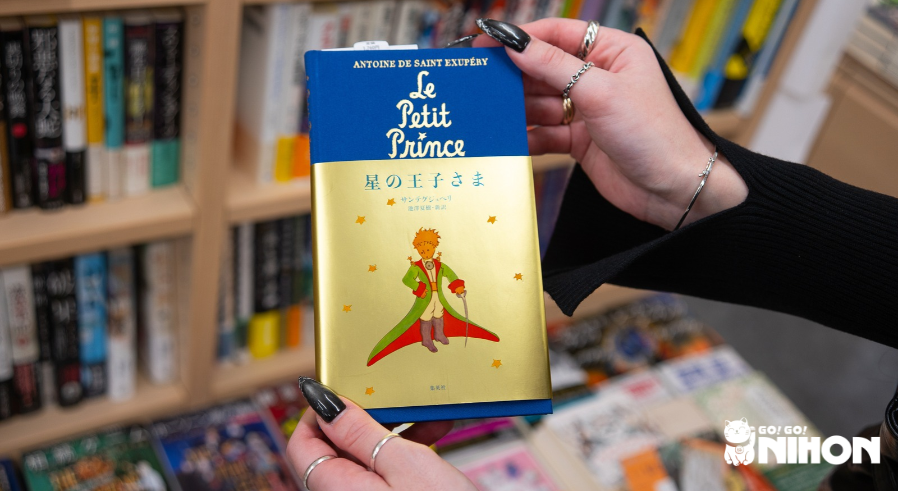
星の王子さま (“The Little Prince”)
This classic is short, and the story is famous around the world. That helps a lot when you meet new words, because you can guess from what you remember.
Level: N4 to N3
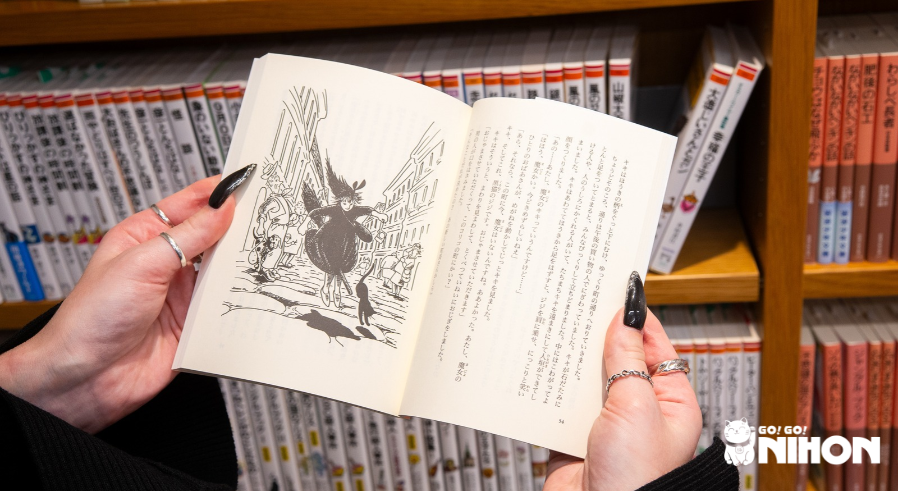
魔女の宅急便 (“Kiki’s Delivery Service”)
Most people know the Studio Ghibli film, but the original novel by 角野栄子 is quite different and has its own charm. It’s a children’s novel about a young witch starting her own delivery business, so the language is simple and the story is easy to follow.
Level: N4 to N3
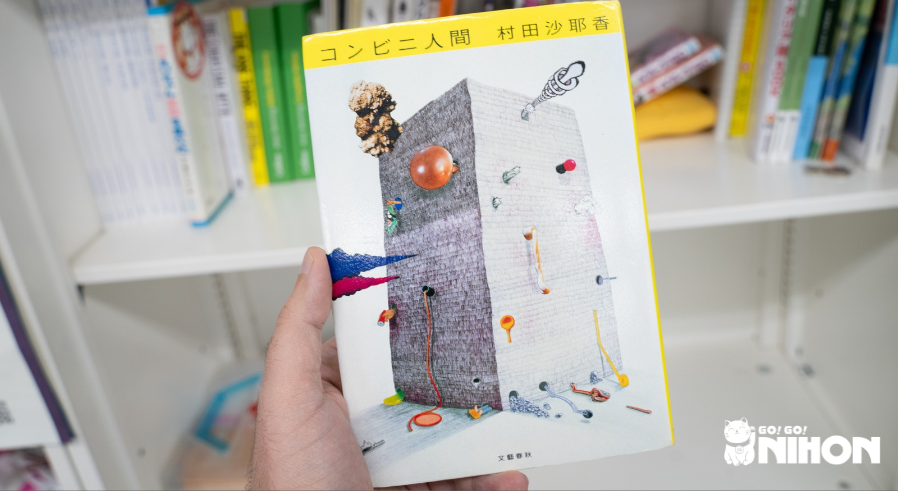
コンビニ人間 (“Convenience Store Woman”)
Sayaka Murata’s short novel is set in an everyday place that learners can picture easily. Convenience store Japanese is also very useful in real life, which includes greetings and the various things staff say all day.
Level: N3
N2: stories you already know
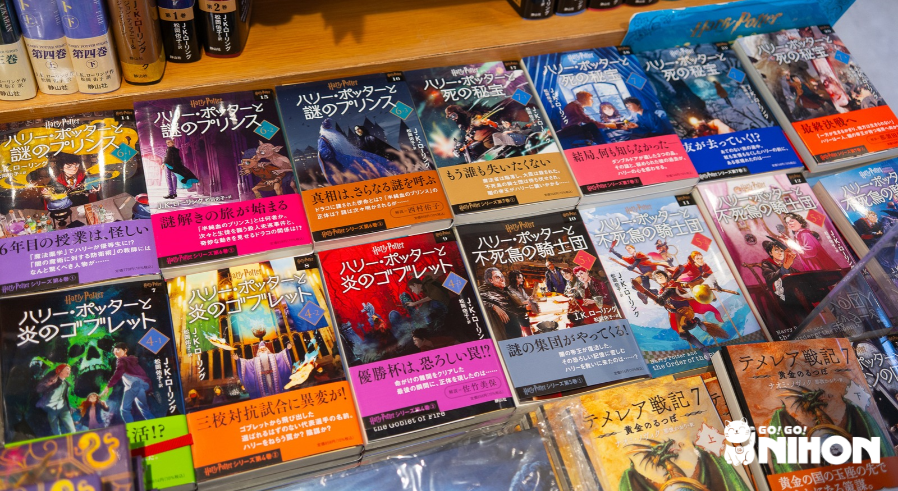
ハリー・ポッターと賢者の石 (“Harry Potter and the Philosopher’s Stone”)
The first book is long, but you already know the story, which makes the Japanese much easier to follow. It’s also a good way to pick up fantasy vocabulary.
Level: N3 to N2
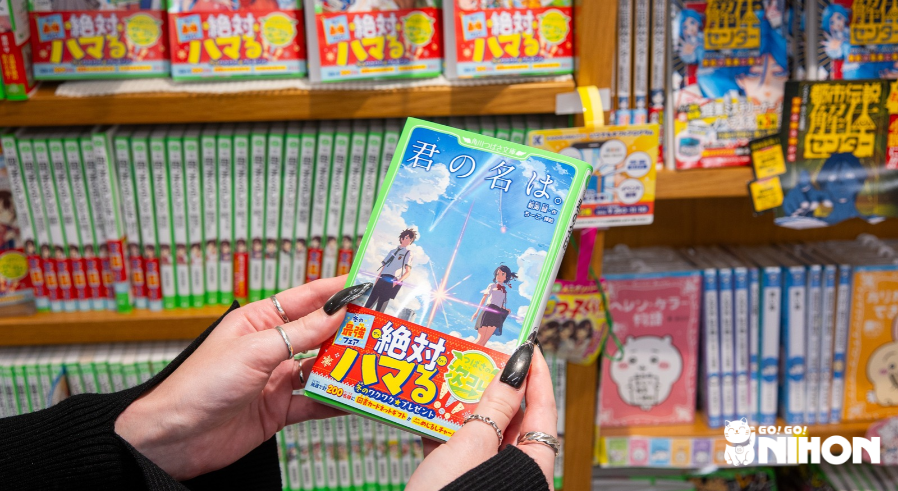
小説 君の名は。 (“Your Name,” the novel)
If you loved the film, the novel by Makoto Shinkai lets you spend more time inside the characters’ thoughts. Knowing the plot first helps you keep going when the sentences get longer.
Level: N3 to N2
N1: a goal book
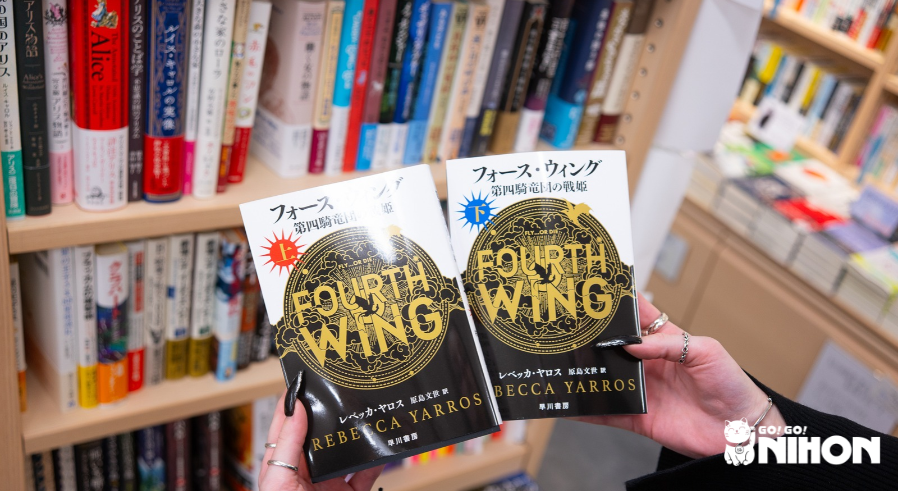
フォース・ウィング (“Fourth Wing”)
This one is for advanced readers, or for anyone who wants a big goal to work toward. Rebecca Yarros’s romantasy is a huge hit in Japan, where it won the translated fiction category of the 2025 Japan Booksellers’ Award. It comes in two volumes (上 and 下), and the vocabulary around dragons and military life is demanding. If you can read it, congrats, because you’re reading at a very high level.
Level: N2 to N1
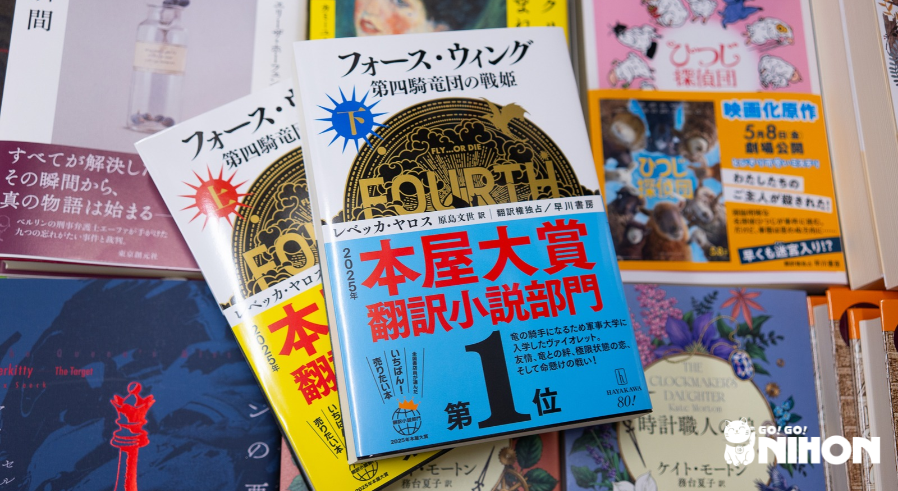
Why some Japanese books come in two parts
If a Japanese book has 上 or 下 on the cover or spine, it’s one story split into two volumes. 上 (jō) means up or above, and 下 (ge) means down or below. In a book, that just means the first half and the second half. The full words are 上巻 (jōkan) and 下巻 (gekan), and 巻 (kan) means volume.
Publishers in Japan often do this with long novels, including translated ones like “Fourth Wing.” Some very long books are split into three parts: 上, 中 (chū, middle), and 下.
Here are a few things to know before you shop:
- Check for both volumes. The two parts are usually sold as separate books, so make sure you pick up both.
- Up and down don’t mean easy and hard. They only tell you the order. The Japanese level is usually about the same across both volumes.
- One volume is a goal in itself. If a full novel feels like too much, finishing 上 is a great milestone.
How to choose a book at your level
- Check for furigana. Furigana are the small hiragana above kanji. They make a book much easier, especially at N5 to N3.
- Read the first page. If you can follow most of the words without stopping, it’s a good fit. If you’re looking up every other word, try an easier book.
- Pick a story you already know. Translated books you’ve read before are a great shortcut.
- Start with something fun. You’ll keep reading if you enjoy it, even if it’s easier than your level.
FAQ
What’s the best first Japanese book for beginners?
For N5 and N4 learners, we’d start with an illustrated book or a picture book with short text and furigana or hiragana only. Our team’s picks are “The Boy, the Mole, the Fox and the Horse” and ようかいのずかん.
Can I read Japanese novels at N3?
Yes. At N3, you can start on simple novels, especially children’s novels and short books about everyday life. “Kiki’s Delivery Service” and “Convenience Store Woman” are good places to begin.
Do JLPT levels apply to books?
Not officially. The JLPT is a test, so there’s no official level for any book. The levels in this article are our team’s estimates based on vocabulary, kanji, and sentence length, so use them as a rough guide.
Is it better to read translated books or Japanese originals?
Both work. Translated books are easier because you already know the story. Japanese originals show you how Japanese people write and talk. A mix is a great way to build your skills.
Where can I buy these books in Japan?
Large bookstores in Japan should have most of them, and many have a section for translated fiction and one for children’s books. Online stores and used bookstores are good options for cheaper copies.
Ready to read your way through Japan?
If you’re learning Japanese and thinking about studying in Japan, we can help you find a school that fits your level and goals. Contact us to learn more and make sure to check out our blog for more information about Japanese study, language, and life in Japan.