Guide to Schools in Japan for International Students
This guide details how to study abroad in Japan for foreign students, including processes, visas, costs, top destinations, and expert tips. Discover more.
 Skip to content
Home • Studying Abroad in Japan • Schools in Japan • Trade Schools in Japan
Trade schools or vocational schools in Japan, known as senmon gakko, are specialized institutions that provide practical training and a high-speed path to a work visa.

Trade schools or vocational schools in Japan, known as senmon gakko, are specialized institutions that provide practical training and a high-speed path to a work visa. For a comprehensive breakdown of how these vocational programs compare to other pathways, explore our primary schools in Japan for international students roadmap.
However, recent regulatory changes and an evolving labor market mean that vocational education can be a great option for career seekers. If you are still in the early stages of planning your move, check out our ultimate guide on studying abroad in Japan to map out your general visa and living logistics.
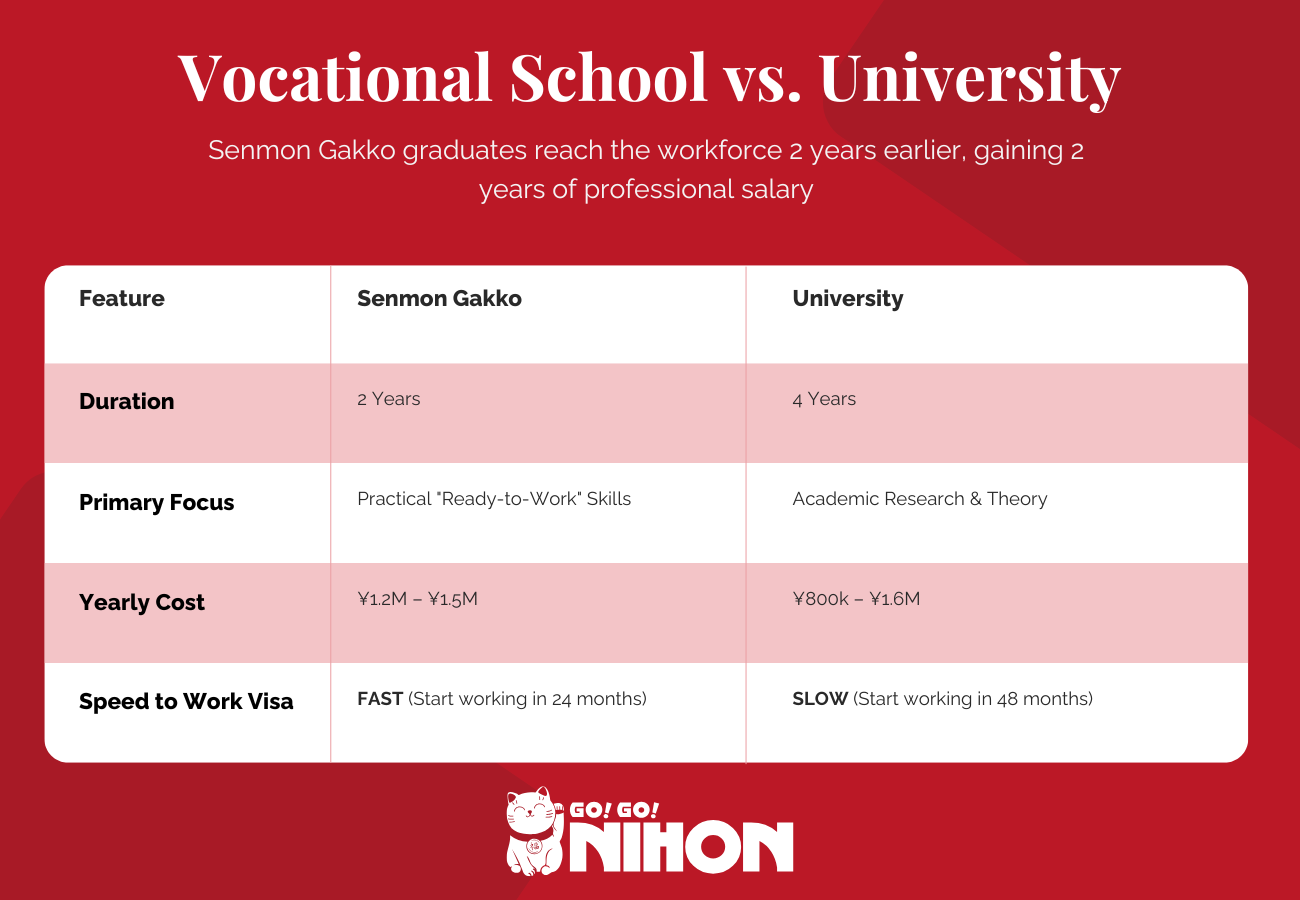
Choosing between a vocational diploma and a university degree depends on your career goals, timeline, and the type of qualification you need for your visa. A university degree offers a broader, globally recognised academic qualification, while vocational schools focus on practical, career-based skills that can help you succeed in the Japanese workplace.
University degrees typically take four years to complete, whereas vocational schools offer programmes where qualifications can often be earned in two years. Your long-term career goals and preferred learning style will help determine which option is right for you.
It is important to note that the high employment success seen in vocational schools is often linked to the rigorous language standards required for entry. Students who reach the JLPT N2 level before enrolling are already highly valued by Japanese employers for their communication skills and cultural adaptability.
| Feature | Senmon Gakko (Trade School) | University |
|---|---|---|
| Standard Duration | 2 Years (Diploma) | 4 Years (Bachelor’s) |
| Primary Focus | Hands-on Technical Skills | Theoretical & Academic Research |
| Visa Eligibility | Qualifies for a Work Visa* | Qualifies for a Work Visa |
| Job Flexibility | High (Post-February 2024) | High |
| Entry Requirement | JLPT N2 Proficiency | JLPT N1/N2 or EJU for Japanese programs. English taught programs vary. |
A university degree offers a broader, globally recognised academic qualification, while vocational schools focus on practical, career-based skills that can help you succeed in the Japanese workplace. If you decide that a traditional four-year degree aligns better with your academic expectations, you can view your options for universities in Japan that teach in English.
*NOTE
To qualify for a work visa, you must graduate from a MEXT-certified program with the title of "Diploma" (Senmon-shi) and secure a professional job offer. Not all vocational certificates carry this status.
Yes, Japan has a robust network of over 2,800 vocational colleges, officially categorized as Professional Training Colleges.
While universities often focus on theoretical and academic research, trade schools or senmon gakko focus almost exclusively on “ready-to-work” skills. These institutions are regulated by the Ministry of Education (MEXT) and are designed to fill specific gaps in the Japanese workforce. For international students, these schools represent a vital bridge between personal passions and the legal right to live and work in the country.
Trade schools in Japan, also called Professional Training Colleges, offer highly specialized programs in technology, creative arts, service industries, and healthcare.
Most programs are two years long, though some advanced tracks extend to three or four years. The curriculum is hands-on, often developed in direct partnership with Japanese corporations to ensure graduates are prepared for immediate employment. Popular fields for international students include:
DID YOU KNOW?
Enrollment in Japanese vocational schools saw a staggering 64.9% increase recently following government efforts to integrate more foreign talent into the specialized workforce.
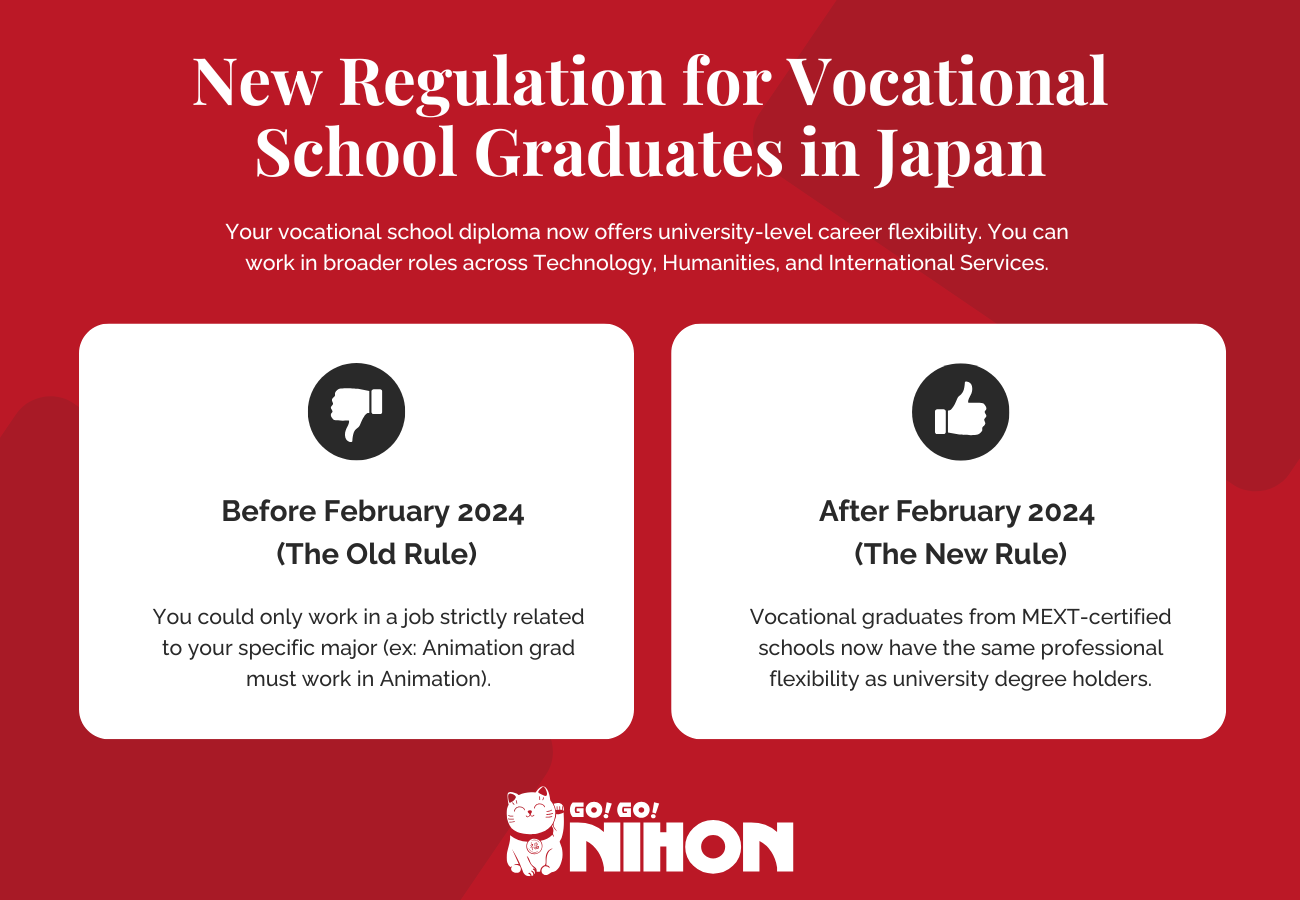
A landmark regulatory change in February 2024 has significantly increased the value of a two-year vocational diploma.
Previously, trade school graduates were often restricted to jobs strictly related to their specific major. For example, an animation graduate might have struggled to get a visa for a general IT role. Under the new rules, graduates from MEXT-certified professional training colleges enjoy significantly expanded employment options. This change effectively removes the “lesser degree” stigma, making a two-year senmon gakko diploma stronger for those pursuing a long-term career in Japan.
DID YOU KNOW?
Enrollment in Japanese vocational schools reached over 76,402 international students in 2024. This record high is driven by these clear legal pathways that turn specialized education into a legitimate right to live and work in the country.
Japanese vocational schools follow a “career-first” educational model that prioritizes high-end technical skills and immediate employability over theoretical academic research.
Unlike universities, where students spend significant time in large lecture halls, senmon gakko typically operate in smaller, community-focused environments with a curriculum designed in direct collaboration with Japanese corporations. These institutions are officially recognized as higher education providers and must meet strict national standards for faculty expertise and facilities.
The senmon gakko curriculum focuses on hands-on training using industry-grade equipment and instruction from active professionals.
To ensure students learn current industry standards, schools frequently hire experts who are still active in their fields. Class sizes are typically kept small, ranging from 20 to 30 students, allowing Western students to avoid the “lost in the crowd” feeling and interact directly with their instructors. This structure facilitates:
Graduating from a trade school grants you a specific title that determines your eligibility for future work visas and higher education.
Not all vocational programs are created equal, so choosing a MEXT-certified Professional Training College is a critical step in your planning process. The title you earn is based on your total class hours and the accreditation of the institution. Academic standards are monitored by prefectural governors to maintain quality across the network of over 2,800 institutions.
| Title | Requirement | Legal Standing |
|---|---|---|
| Diploma (Senmon-shi) | 2–3 Year Program (1,700+ Hours) | Can qualify for a Work Visa application |
| Advanced Diploma (Kodo-Senmon-shi) | 4 Year Program (3,400+ Hours) | Equal to a Bachelor’s degree in Japan; grants entry to graduate schools and qualifies for a Work Visa application. |
*NOTE
To qualify for a work visa, you must graduate from a MEXT-certified program with the title of "Diploma" (Senmon-shi) and secure a professional job offer. While most two-year diplomas qualify, some shorter or uncertified vocational certificates do not carry this legal weight.
Graduating from a Japanese trade school offers a high return on investment through high employment rates and often direct pipelines into major Japanese industries.
Unlike many general university degrees, a senmon gakko education is an investment in a specific outcome. Because the curriculum is designed to solve Japan’s acute labor shortages, evidenced by the record high of 336,708 international students reported in the 2024 JASSO survey, graduates can be recruited by companies months before they even receive their diplomas.
While many trade schools report employment rates exceeding 90%, these figures are often achieved by students who have already achieved JLPT N2 before enrollment.
For international students, the high success rate is typically a reflection of their advanced language skills combined with specialized technical training.
Specialized training colleges have strong connections in their industry, they offer alumni networks and partner with industry leaders to career support. Instructors are often active professionals, making these connections vital for working in Japan as an international student. For example:
DID YOU KNOW?
By the time you graduate, you are not just a student with a degree; you are a professional with a network of peers and mentors already embedded in the Japanese workforce.
To qualify for a trade school in Japan, you must meet specific academic, linguistic, and financial standards. Because these programs are taught entirely in Japanese alongside domestic students, the entry requirements are designed to filter for candidates who can succeed in a fast-paced technical environment.
The table below summarizes the core criteria you must meet to secure your place and protect your future eligibility for a work visa in Japan.
| Category | Primary Requirement | Required Documentation |
|---|---|---|
| Academic background | 12 years of formal education | High school diploma or graduation certificate |
| Japanese language | JLPT N2 proficiency or equivalent | Official JLPT N1/N2 certificate, EJU score (200+), or BJT score (400+) |
| Language alternative | 6 months of study at a recognized language school | Attendance and grade certificates from a MEXT-certified language school |
| Financial stability | Proof of funds for tuition and living costs | Bank balance certificate showing ¥2.0 to ¥2.6 million |
| Legal status | Valid passport and age of 18 or older | Passport copy and birth certificate (if required) |
| Institutional proof | Successful completion of entrance exams | Passing scores on the school’s internal written test and interview |
To qualify for a vocational program, you must have completed 12 years of formal education and hold a JLPT N2 certificate or equivalent.
The Japanese education system is strict regarding your academic background. If you have only completed 10 or 11 years of schooling in your home country, you may be required to complete a designated “preparatory education” course in Japan before you can enroll in a trade school.f
Linguistically, you must prove you can follow technical lectures and participate in hands-on workshops. Accepted certifications typically include:
DID YOU KNOW?
Reaching JLPT N2 typically requires 600 to 900 hours of study. Most international students spend 1 to 2 years at an intensive Japanese language school to reach this fluency before beginning their trade school application.
Securing your spot requires navigating a bureaucratic system centered on your Statement of Purpose and the Certificate of Eligibility (COE).
The application process typically begins 6 to 8 months before your intended start date (usually April). Unlike university applications in the West, Japanese vocational schools often require a handwritten curriculum vitae (CV) and a Statement of Purpose. This statement is a critical document where you must clearly explain your motivation for choosing that specific trade and how it aligns with your future career in Japan.
Once your paperwork is reviewed, you will face the Entrance Exam, which often includes:
To make sure your documentation is organized perfectly, follow our guide on how to apply for a Japan student visa.
Applicants must provide proof of financial security, typically showing a bank balance of 15,000–20,000 USD to secure a student visa.
Japanese Immigration requires comprehensive proof that you can support yourself without relying solely on part-time work. You must submit your financial supporter’s bank statements and income tax certificates for the past three years. Officials look for a history of stable income to ensure you can remain focused on your studies while adhering to the legal 28-hour weekly work limit.
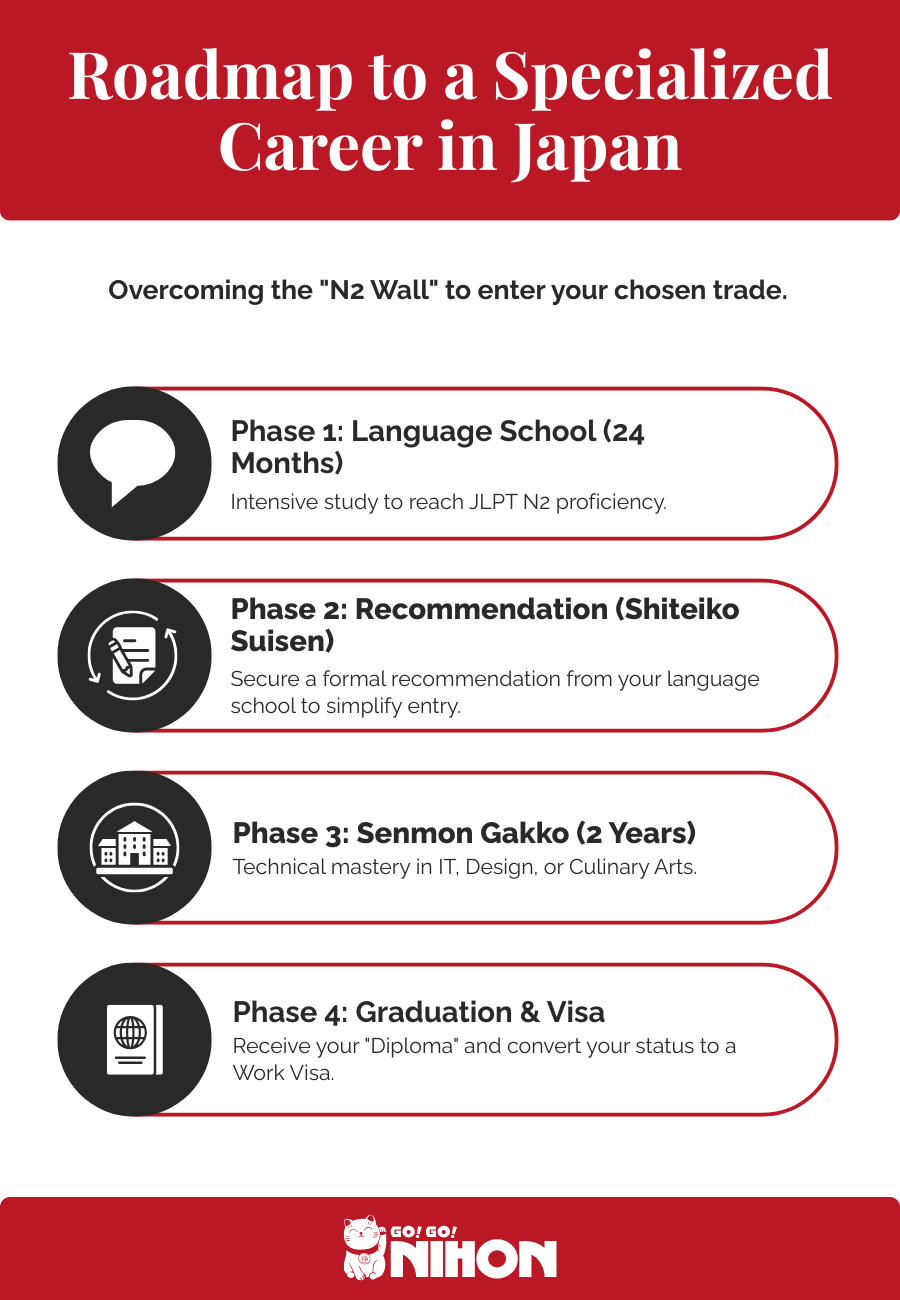
If you have not yet met the N2 Japanese requirement, enrolling in a language school with an established vocational pathway is the most reliable way to secure your future in a trade school in Japan. These progression pathways allow you to build your linguistic foundation while receiving expert guidance on your specialized application.
International students pursuing technical education in Japan typically progress from a Language School (6-24 months) to achieve JLPT N2 and secure a recommendation, then to Vocational School (2 years) for a Technical Diploma (Senmon-shi), and finally to the Workplace for a professional job and work visa.
| Phase | Primary Goal | Typical Duration |
|---|---|---|
| Language School | Reach JLPT N2 and secure a recommendation | 6 to 24 Months |
| Vocational School | Earn a Technical Diploma (Senmon-shi) | 2 Years |
| Workplace | Secure a professional job and work visa | Upon graduation |
Preparing application documents can be complex, but Go! Go! Nihon provides expert support to help you organize your Japan Student Visa application correctly the first time.
While it is technically possible to apply to a senmon gakko directly, most vocational administrations operate exclusively in Japanese. Managing high-stakes immigration requirements and school-specific entrance exams without an intermediary often leads to avoidable delays or application rejections.
Our goal is to handle the logistics so you can focus on mastering your craft and reaching that essential N2 proficiency level. Contact Go! Go! Nihon today to begin your free application process.
First-year fees for Japanese trade schools (Senmon Gakko) average ¥1,300,000, which is mid-range compared to language schools and private universities. Though higher than language programs, this is a good investment as it leads to specialized jobs. The first year is costlier due to one-time admission and registration fees.
Vocational programs typically require a ¥200,000 enrollment fee, plus annual tuition that varies by field. Students must also budget ¥40,000 to ¥100,000 yearly for “Facility and Equipment Fees” to cover technical maintenance.
| Expense Type | 2-Year Diploma (Senmon-shi) | 4-Year Advanced Diploma |
|---|---|---|
| Enrollment Fee | ~¥200,000 (One-time) | ~¥200,000 (One-time) |
| Annual Tuition | ¥820,000 – ¥1,200,000 | ¥1,000,000 – ¥1,400,000 |
| Facility Fees | ¥40,000 – ¥100,000 | ¥40,000 – ¥100,000 |
| Approx. USD Total | $5,500 – $8,000 USD | $6,700 – $9,300 USD |
Creative and technical fields that require high-end equipment, such as game development or culinary arts, tend to fall on the higher end of the tuition scale.
Programs that rely heavily on specialized gear require larger equipment budgets. For example:
By understanding these costs upfront, you can better prepare your financial documentation for your student visa application.
Yokohama Design College (YDC), established in 1948, is a MEXT-approved institution specializing in digital arts, fashion, and visual design. Uniquely, it combines its specialized vocational departments with a Japanese language department in the same building, enabling simultaneous language and professional studies.
Industry Placement: Whether you want to work in visual arts, manga illustration, or fashion, YDC leverages decades of alumni success and deep industry partnerships to help you find a job in Japan.
Graduates with technical certifications are highly sought after in Japan’s hospitality, information technology, and construction sectors.
Japan is currently facing an acute labor shortage, with the 2024 JASSO survey reporting a record high of 336,708 international students helping to fill these gaps. Companies are increasingly looking for specialized talent who can bypass lengthy corporate training. High-demand roles include:
Japanese trade schools, or senmon gakko, provide a strategic and high-ROI pathway to a specialized career and long-term residency in Japan.
Choosing to study at a vocational school allows you to master practical skills in high-demand fields like IT, gaming, and design while reaching the workforce two years faster than a typical university graduate. With the landmark February 2024 visa relaxations granting vocational grads the same professional mobility as degree holders, there has never been a more efficient time to turn your technical passion into a legitimate work visa. By overcoming the “N2 Wall” through a dedicated language foundation, you can secure a professional future in a labor market that is increasingly eager to integrate international talent.
Skip the wait and start your degree now. Contact Go! Go! Nihon for free trade school placement support.
Explore your vocational options and find the perfect program at our trade school in Japan.
This guide details how to study abroad in Japan for foreign students, including processes, visas, costs, top destinations, and expert tips. Discover more.

This guide details how to study abroad in Japan for foreign students, including processes, visas, costs, top destinations, and expert tips. Discover more.

This guide details how to study abroad in Japan for foreign students, including processes, visas, costs, top destinations, and expert tips. Discover more.

This guide details how to study abroad in Japan for foreign students, including processes, visas, costs, top destinations, and expert tips. Discover more.

This guide details how to study abroad in Japan for foreign students, including processes, visas, costs, top destinations, and expert tips. Discover more.