Skip to content


Immigration no longer accepts a simple 150-hour study certificate as proof of Japanese ability. Schools must now verify your language level themselves, which means most applicants will complete some form of interview or placement test before their student visa application moves forward. The format varies a lot by school; there’s live Zoom interviews, written grammar tests, and recorded videos to submit. This guide walks through why these checks exist, the main types you might encounter, and how to prepare for them.
What’s this new student visa process?
If you’ve started looking into a student visa for Japan recently, you may have noticed a new step in the process: a school interview or assessment. This is because of a change in immigration policy.
Student visa applicants are generally expected to have a basic level of Japanese ability. In the past, evidence of around 150 hours of study could be used as proof. As of the October 2026 intake, immigration has changed the requirements. Applicants are now typically expected to demonstrate their level through an official exam result (such as JLPT N5 or equivalent) or by completing a school assessment/interview. Please note that some schools may require both.
Schools are now expected to confirm your basic language ability themselves, as it is much more difficult to obtain an official exam result outside of Japan. This shift is why so many schools have introduced their own interviews, tests, and assessments.
Why are schools interviewing students?
Schools have a few reasons for adding this step.
- Visa sponsorship responsibility — Since schools are the ones sponsoring your student visa, immigration expects them to confirm you meet the basic language requirement themselves.
- A real foundation in Japanese is now expected — Applicants are generally expected to arrive with some basic Japanese language skills, usually an N5-level foundation.
- Accurate class placement — A quick assessment also helps the school place you in the right level from day one, so you’re not stuck in a class that’s too easy or too advanced.
Here’s some key vocabulary you’ll come across while navigating this process:
| Japanese | Romaji | English |
| 面接 | mensetsu | interview |
| 在留資格 | zairyū shikaku | status of residence |
| 留学 | ryūgaku | study abroad |
| 入学 | nyūgaku | school enrollment |
| 出席 | shusseki | attendance |
| 証明書 | shōmeisho | certificate |
What do the school tests actually look like?
Because every school designs its own process, the school tests vary according to school. The format can range from a casual video call to a fully written exam. Broadly speaking, though, most fall into one of three categories: oral communication and speaking, traditional review and written tests (like JLPT level N5), or document and history verification.
Focus on oral communication and speaking
Some schools care most about how you handle a real conversation. This usually means a live video interview, a mix of speaking tasks and multiple-choice questions, or a short video you record and submit.
The goal: testing your quick responses, listening comprehension, and ability to handle daily, practical communication.
Examples:
- 30-minute Zoom interview combined with an oral test and multiple-choice questions.
- Google form test paired with a recorded speaking upload, to check your handling of everyday grammar patterns like requests and permissions.
Traditional review and written tests (JLPT N5 level)
Other schools lean on more familiar territory: paper-based or online tests built around textbook basics like kanji, grammar rules, particles, and conjugation.
The goal: confirming you’ve reached baseline JLPT N5 or beginner-level proficiency.
Examples:
- Practical beginner review covering basic kanji, counters, particles, and simple classroom instructions.
- Comprehensive test structured like the JLPT itself, covering reading comprehension, kanji application, and vocabulary.
- Traditional, grammar-heavy test focused on sentence completion, particles, and verb and adjective conjugation.
Document and history verification
A small number of schools put less weight on a live language exam and more on your paper trail.
The goal: verifying your actual study hours, attendance consistency, and learning history.
Example:
- Official study records and attendance certificates rather than a formal language test.
Can you fail the interview?
Yes, you can fail the interview. In some cases, if a student does very poorly on their assessment, the school may say that they can’t offer them a place until they can successfully pass it in the future. Remember, it varies by school, and while some schools may allow students to retake the assessment (sometimes for a fee), others may require them to wait until next term before taking it again.
Here are a few red flags that can lead to rejection or delays:
- A complete inability to read hiragana or katakana, or to answer beginner-level N5 questions.
- Trouble explaining your financial sponsorship clearly.
- Any sign that you’re using a student visa for a reason other than studying, such as an intention to work illegally.
Quick preparation tips
- Skip the AI and translation tools on your written application. A live interview or school test will quickly reveal any gap between your application and your actual ability. Plus, you can’t trust these tools to provide you with a native-level language level for any language.
- Practice your jikoshōkai. Be ready to give your name, age, country, and reason for studying in Japanese. A few basics to know:
| Japanese | Romaji | English |
| 自己紹介 | jikoshōkai | self-introduction |
| 名前 | namae | name |
| 年齢 | nenrei | age |
| 出身 | shusshin | hometown, origin |
| 目標 | mokuhyō | goal |
| 理由 | riyū | reason |
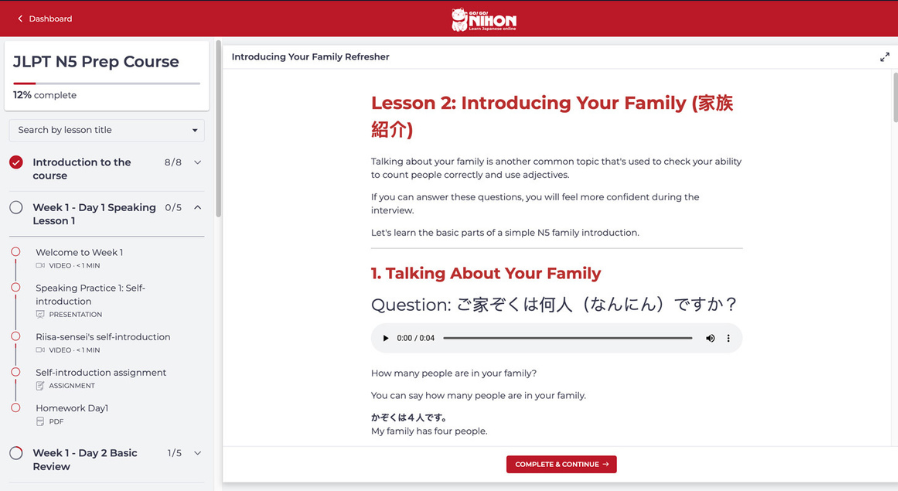
- Brush up on your basics. Review your particles, verb conjugations, and core N5 kanji. Go! Go! Nihon recently released a new online three-week course, the JLPT N5 Prep Course, to help you with the basics and the speaking interview as well.
- Test your setup ahead of time. Check your camera, microphone, and internet connection before a video interview.
- Let your motivation show. Even if your Japanese isn’t where you want it yet, showing genuine motivation to study goes a long way.
FAQ
-
Do all Japanese language schools now require an interview?
Most schools have added some form of interview, test, or document check, but the exact format is set by each school individually. There’s no single standard test used across the industry.
-
What happens if I don’t pass my school’s assessment?
It depends on the school. In some cases, if a student does very poorly on their assessment, the school may say that they can’t offer them a place until they can successfully pass it in the future. Some schools may allow students to retake the assessment (sometimes for a fee), others may require them to wait until next term before taking it again.
-
Do I need to know Japanese before applying to a language school?
Yes, a basic foundation is now generally expected before you apply, rather than something you build entirely after arriving in Japan.
-
Why did the 150-hour study requirement change?
Immigration moved away from accepting a study hours certificate alone as proof of ability, and now expects schools to confirm applicants’ language level directly.
-
How can I prepare for a Japanese language school interview?
Practice a simple self-introduction in Japanese, review N5-level grammar and kanji, and test your video call setup in advance if the interview is online.
Get a head start on your Japanese
Walking into your school interview with even a little preparation makes a real difference. If you want structured support before you apply, our online courses can help you build the basics:
- Akamonkai Japanese 12-Week Beginner Course
- Japanese Beginner Communication Bundle
- Beginner Communication Course
- JLPT N5 Prep Course
Whichever school you’re applying to, showing up with a genuine foundation in Japanese, and genuine motivation, is the best preparation you can have.
To learn more about moving to Japan to study Japanese, don’t hesitate to contact us. And make sure to check out our blog to find out more about life in Japan, learning Japanese, and other bureaucratic processes.